Stop Hiring Bad Fits: The 5-Step Insurance Agency Hiring Fix
Craig and Jason are licensed P&C agency owners, co-authors of Million-Dollar Agency, creators of the trademarked Telefunnel, hosts of The Insurance Dudes podcast, and speakers.
Written and reviewed under our editorial process. Found an error? See our corrections policy.
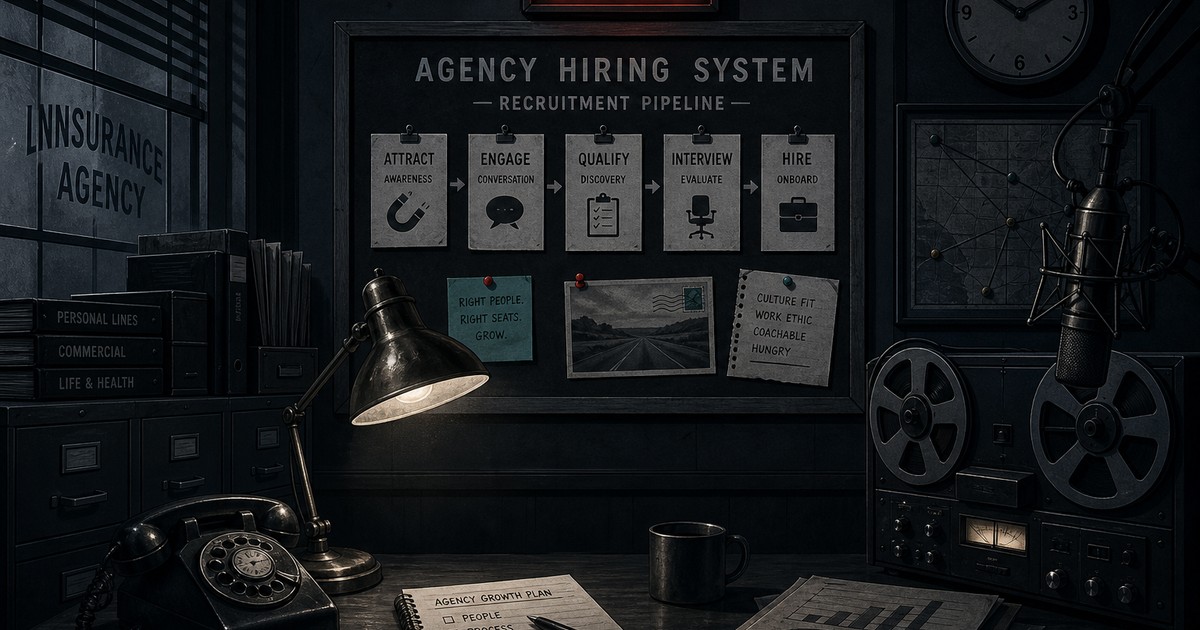
Insurance agency owners hire out of desperation instead of running a real recruiting pipeline. The five steps that fix it: run paid traffic continuously, assess candidates with DISC before any interview, run group interviews to expose real behavior, use one-on-ones for final selection, and onboard every new hire against a written 30/60/90 success plan.
TL;DR
The reason most agency hiring cycles feel like a revolving door is that the process is built backward: reactive, rushed, and interview-only. Fixing it means treating recruitment like lead gen with measured stages. Run paid candidate traffic continuously, screen with assessments before the first conversation, use group interviews to expose real behavior, reserve one-on-ones for final selection, and onboard to written 30/60/90 success definitions. A bad producer hire costs your agency months of lost production and training waste before you even start the search again.
A working P&C hiring system has five stages, every time, whether you have an opening or not. Run paid traffic on Indeed, Facebook, or LinkedIn so the applicant pipeline stays full. Assess every candidate with DISC before any human interview. Run group interviews to see how candidates behave around other driven people. Use structured one-on-ones only for finalists who cleared the earlier filters, then onboard with 30, 60, and 90-day success criteria plus daily activity minimums.
Why does the way most P&C agencies hire keep producing the same bad outcomes?
The hiring patterns that cause agencies to cycle through producers follow a predictable script. Someone leaves or underperforms. Production dips, the owner feels the pressure, and a job posting goes live the same afternoon. Within two weeks, three candidates do solo interviews. The owner picks the best interviewer, offers by Friday, and a new producer is in the chair Monday.
The problem is not the owner's judgment, it is that the process was designed by urgency. Every quality-control stage gets compressed or dropped. Assessments feel like a delay when you need someone dialing tomorrow. Group interviews seem like a luxury when you are down a producer. Reference checks get rationalized away because the candidate made eye contact.
The math makes it worse. Average annual turnover in sales sits at 25 to 30 percent, meaning the equivalent of an entire sales organization cycles through every four years (Harvard Business Review, November 2015). Even satisfied sales professionals are hunting: 41 percent are actively searching for a new position (Harvard Business Review, April 2022). The talent market is not neutral, it is hostile to retention by default. Agencies that hire reactively feed a churn cycle that was already spinning.
Beyond the churn, insurance faces a demographic cliff. The industry will need to fill an estimated 400,000 open positions as experienced professionals retire, according to research cited by Risk and Insurance, and voluntary turnover remains elevated at over nine percent annually (Risk and Insurance, January 2025). The U.S. Bureau of Labor Statistics projects about 47,000 openings for insurance sales agents each year over the next decade (Bureau of Labor Statistics, 2026). More openings plus fewer qualified candidates equals the exact environment where desperation hiring thrives.
What are the five steps of a hiring system that actually works in an agency?
The five-step framework from the Insurance Dudes mailbag episode is built around a single principle: treat recruitment identically to lead generation. Measure every stage, track conversion rates, and never let the pipeline run dry. It works because it assumes the agency already has clear role separation so you know exactly which seat you are filling before the first resume arrives. The difference between agencies that hire well and those that cycle through producers is not instincts, it is process.
Step 1: How do you build an always-on candidate pipeline?
The first structural problem with reactive hiring is that the applicant pool is whatever happens to be available in a two-week window. Continuous paid traffic changes the math. Running baseline ads on Indeed, Facebook, or LinkedIn at a modest monthly spend, regardless of whether you have an opening, means you are always collecting qualified applicants. When a seat opens, you start from people who have already expressed interest and passed an initial screen.
The unit economics mirror lead gen. A healthy producer hiring funnel: 100 resumes to roughly 30 first-outreach responses to 12 first interviews to 6 second-rounds to 3 offers to 2 accepts to 1 person retained past 90 days. The numbers force you to keep recruiting even when fully staffed because turnover is constant.
If you only hire when the seat is empty, your funnel collapses to the bottom three stages. You pick from whoever lands in your lap, and that is never your first choice.
Step 2: Why should assessments come before any human interview?
Interviews are performance art. Every candidate presents their best self for 45 minutes. The interview measures interview skill, not job skill. Assessments add a dimension of information that interviews systematically miss.
Research shows that personality-based assessments can predict candidate performance before the first conversation, reducing the risk of hiring on charisma alone (Harvard Business Review, November 2015). The DISC behavioral framework, in particular, maps directly to sales roles: High Dominance plus moderate Influence correlates with prospecting, objection handling, and asking for the business. High Steadiness plus high Compliance maps to retention and client care. Running the assessment before the first interview reveals whether a candidate's natural wiring matches the role before you invest an hour in conversation.
Running assessments on every candidate creates consistency. You apply the same measurement to everyone, not selectively based on gut feel. The assessment does not make the decision, but it tells you where to look during the interviews that follow.
Step 3: What do group interviews reveal that individual ones cannot?
Individual interviews happen in a vacuum: one candidate, one interviewer, controlled impressions. Group interviews break that vacuum. Multiple candidates in the same room, or on the same video call, for a structured session of demonstration, response, and observation.
The behaviors that emerge in a group setting are the behaviors that matter in an agency. Does the candidate engage or withdraw when someone else makes a strong point? Do they build on contributions or compete with them? Can they hold presence when the spotlight moves? These are the dynamics of a real sales floor, exposed before you make the hire rather than three weeks after.
Position group interviews as the second stage, after assessment screening but before solo conversations. Filtered candidates compete in a realistic environment. The ones who rise earn deeper one-on-one time. The ones who fade or posture just saved you hours of interviews.
Step 4: How do you structure the final interview for best-fit selection?
By the time a candidate reaches the individual interview, they have passed the assessment threshold and performed in a group environment. The one-on-one is about fit and depth, not basic competence. Structure the conversation around specific scenarios from your agency: the producer who inherited a service-heavy book and had to prospect out of it, the hire who started cold in a rate-increase market, the team member who had to choose between closing a borderline policy and protecting the loss ratio.
Ask candidates to walk through handling those situations. Listen for process thinking versus personality thinking. Process thinkers describe what they would build or measure. Personality thinkers describe how they would feel or talk. You need process thinkers because process survives a bad month and personality does not.
At this stage you are choosing among qualified finalists, not determining basic qualification. That distinction is the entire difference between a hiring system and a hiring scramble.
Step 5: What does a real onboarding plan look like for a new insurance producer?
Most agencies onboard by feel. The new producer shadows someone for a week, then gets a CRM login and a list of aged leads. Expectations are verbal. Results are unpredictable.
A 30/60/90 onboarding plan changes that. At 30 days: product and script training complete, live-call certification passed, defined dial volume hit. At 60 days: generating quotes independently with a specified quote rate. At 90 days: closing at a minimum threshold with a defined cross-sell rate.
Daily activity standards make those milestones operational. The producer knows exactly how many dials, contacts, and quotes are expected each day. Without a producer system on the agency side, even the best hire defaults to what they did at their last shop. The owner reviews a daily scorecard, not a monthly gut check. Underperformance shows in week two, not month four.
The compensation structure should align with these milestones. Industry research shows producers segment into validated and unvalidated categories, where validated means generating enough new business to cover total comp (Rough Notes, May 2024). A new producer's comp plan should bridge them to validation with a draw or salary that tapers as commission ramps, with clear activity minimums. The right comp structure for a new producer also shapes the type of candidate your pipeline attracts since commission-only postings pull from a different pool than draw-plus-commission.
What does the insurance industry hiring landscape look like right now?
The talent gap is structural and widening. More openings are expected in 2026 and beyond, even as retirements accelerate and Gen Z recruitment remains challenging (PropertyCasualty360, January 2026). Hiring optimism persists industry-wide despite the headwinds, according to a 2025 Risk and Insurance survey, but the same data shows voluntary turnover still running above nine percent annually (Risk and Insurance, August 2025). Agencies that lead with "we work hard and grind" are filtering out the largest talent pool available.
None of this changes the fundamentals. The pipeline step handles sourcing regardless of demographics. DISC measures behavioral patterns, not age-cohort preferences. The format of group interviews, one-on-ones, and onboarding works across generations.
What the data adds is urgency. Agencies that build structured hiring systems now will be choosing from a shrinking talent market while competitors are still posting reactively.
What is the bottom line on building a 5-step hiring system for your insurance agency?
The five steps are not complicated. Continuous paid candidate pipeline, DISC assessments before interviews (the same behavioral framework that powers producer hiring decisions), group interviews before solo conversations, structured one-on-ones with finalists only, and written 30/60/90 onboarding with daily activity standards. Each step removes a failure mode that reactive hiring leaves in place.
What makes the system work is that it runs all the time, not just when you have an opening. Sustaining that clarity beyond the hire requires consistent team communication habits, because a structured onboarding handoff to an unstructured daily environment will still lose people. When the next producer leaves, you have candidates in process who already cleared the first two filters. You make a selection, not a compromise. That is the difference between hiring heroes and living through nightmares.
Sources cited in this analysis?
- Harvard Business Review -- The Best Ways to Hire Salespeople (November 2015)
- Harvard Business Review -- How to Retain Your Best Sales Talent (April 2022)
- Risk and Insurance -- 5-Year Report Card: Attracting New Talent (January 2025)
- Risk and Insurance -- Hiring Optimism Despite Talent Challenges (August 2025)
- PropertyCasualty360 -- 2026 Trend Forecast: The Insurance Workforce (January 2026)
- Rough Notes -- Trends in Insurance Agency and Brokerage Compensation (May 2024)
- U.S. Bureau of Labor Statistics -- Insurance Sales Agents Occupational Outlook (2026)
Listen to The Insurance Dudes Podcast
Get more strategies like this on our podcast. Available on all platforms.
Related Episodes

Stop Hiring Out of Desperation: The 5-Step Hiring Fix

What a Bad Producer Hire Actually Costs Your P&C Agency
BJ Hill: From Basketball Coach to $18 Million Agency
Nathan Glass on Smarter Hiring and Partnership Decisions
Boss Fail: Lessons From My Worst Leadership Mistakes