Stop Hiring Out of Desperation: The 5-Step Hiring Fix
Craig and Jason are licensed P&C agency owners, co-authors of Million-Dollar Agency, creators of the trademarked Telefunnel, hosts of The Insurance Dudes podcast, and speakers.
Written and reviewed under our editorial process. Found an error? See our corrections policy.

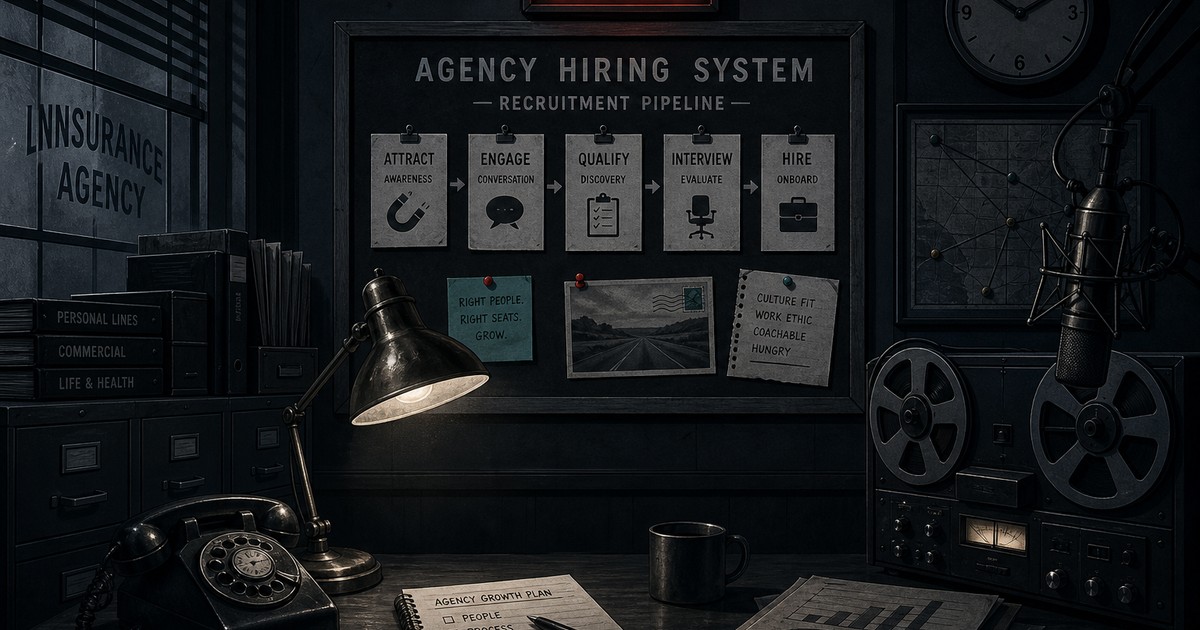
The five-step P&C agency hiring system: run paid traffic continuously so the pipeline is full before you need it, use assessments to see past interview polish, run group interviews to expose real behavior, use one-on-ones to choose between filtered finalists, then onboard with 30/60/90 success metrics and daily activity standards.
TL;DR
Most agencies hire reactively, in a panic, once a seat is already empty, which is exactly why the fits keep failing. The fix is a standing five-step system: an always-on paid candidate pipeline, assessments that see past interview polish, group interviews that expose real behavior, one-on-ones to choose among pre-filtered finalists, and onboarding against clear 30/60/90-day definitions with daily activity standards. Build it before the opening, not after, and if you can only fix one stage right now, make it the always-on pipeline.
A working P&C hiring system has five steps. Run paid traffic on Indeed, Facebook, or LinkedIn continuously so the candidate pipeline is full before you have an opening. Use assessments to see past interview polish. Run group interviews to expose real behavior. Use one-on-ones to choose between candidates who already cleared the filters. Then onboard with clear 30, 60, and 90 day success definitions plus daily activity standards. Build it before the seat opens, not after.
Why does the way most P&C agencies hire keep producing bad fits?
The hiring patterns that plague insurance agencies have a common root: most hiring happens reactively. Someone leaves, production suffers, pressure builds, and the agency makes a hire driven by urgency rather than fit. That dynamic is worse than it looks in the moment, because urgency-driven hiring compresses every quality-control stage of the process. Assessments get skipped. Reference checks feel like bureaucracy. Group interviews seem inefficient when you need someone last week.
The result is a new hire who looked good in a one-on-one interview and turned out to be nothing like what the job required. That hire stays through the initial training period, underperforms for a month or two while consuming management attention, and eventually leaves or is let go, at which point the cycle begins again. Each cycle of reactive hiring costs more than the one before it in time, training investment, and lost production opportunity.
Building a proactive, structured hiring system breaks that cycle. It doesn't eliminate hiring mistakes entirely, nothing does, but it dramatically reduces their frequency and severity by creating consistent quality control at every stage of the process.
What are the five steps of a hiring system that actually works in an agency?
Step 1: Create a predictable candidate pipeline with paid traffic. The first problem with reactive hiring is that the candidate pool is limited to whoever happens to be actively looking when you need someone. Paid advertising on Indeed, Facebook, or LinkedIn, run continuously at a modest budget, not just when you have an opening, keeps your pipeline filled with qualified candidates regardless of your current urgency. When you're always getting applications, you can be selective. When you're only getting them during a crisis, you can't be.
Step 2: Use assessments to see past the interview performance. Every candidate comes to an interview prepared to present their best self. Assessments. DISC profiles, cognitive assessments, sales aptitude tools, reveal characteristics that are invisible in an interview: how someone processes information under pressure, how they handle rejection, where their natural behavioral style creates friction with the job's demands. These tools don't make the hiring decision for you, but they add a dimension of information that interviews systematically miss.
Step 3: Run group interviews before individual ones. Group interviews, bringing multiple candidates in at the same time for a structured session, reveal real behavior in ways that one-on-one conversations don't. How does someone respond when another candidate makes a strong point? How do they handle being asked to demonstrate a skill in front of peers? Who shows up with presence and who disappears into the background? The candidates who perform well in a group interview environment have demonstrated something that individual interviews can't assess.
Step 4: Use structured one-on-ones to choose the best fit. The individual interview stage, positioned after assessments and group interviews, serves a specific purpose: deeper exploration of what you've already learned. This isn't a general "tell me about yourself" conversation, it's a targeted discussion of specific scenarios that reveal character, decision-making, and values alignment. At this stage, you should be choosing between candidates who've already cleared multiple filters, not trying to determine basic competence.
Step 5: Onboard with clarity, define success, set activity standards, focus on behaviors. The hiring process ends and the onboarding process begins, but most agencies treat these as separate systems when they're actually continuous. A great onboarding experience defines success explicitly: what does winning look like at 30, 60, and 90 days? What are the specific daily and weekly activity standards the new hire is responsible for? What behaviors will be tracked, and how will feedback be delivered? New hires who know exactly what winning looks like reach it faster, and the ones who don't aren't going to be a surprise when they underperform.
Which step should you build first if you can only fix one stage right now?
Implementing this system doesn't require overhauling everything at once. Pick the stage in your current process where the most failures are occurring and start there. If you're consistently bringing in candidates who can't sell, the assessment step is your priority. If you're hiring people who interview well but don't last, the onboarding clarity step is your leverage point. If you're always hiring from a pool of one or two candidates, the pipeline step is your foundation.
The one-time investment in building this system, setting up the paid advertising, selecting assessment tools, designing your group interview format, writing your onboarding documentation, pays dividends across every hire you make afterward. The agencies that have built structured hiring systems report dramatically lower turnover, shorter ramp times, and better cultural fit. That's not a coincidence, it's the predictable result of making deliberate decisions instead of desperate ones.
What's the takeaway for owners tired of desperate hires that don't last?
The 5-step hiring framework isn't complicated, it's deliberate. Paid traffic for a continuous pipeline, assessments that reveal what interviews hide, group interviews that show real behavior, structured individual conversations for final selection, and onboarding that defines winning from day one. Each step removes a failure mode that reactive hiring leaves in place. Build the system before you need it, and the next time someone leaves your team, you'll be choosing from candidates rather than accepting whoever showed up.
Catch the full conversation:
Level up your agency:
Listen to The Insurance Dudes Podcast
Get more strategies like this on our podcast. Available on all platforms.
Related Episodes
Why Waiting for a Vacancy Is Your Costliest Hiring Mistake
The Three Pillars of Insurance Agency Culture Explained
Stop Hiring Bad Fits: The 5-Step Insurance Agency Hiring Fix
Nathan Glass on Smarter Hiring and Partnership Decisions
Dr. Nicole Price on Why Empathy Is an Engineering Problem
