What a Bad Producer Hire Actually Costs Your P&C Agency
Craig and Jason are licensed P&C agency owners, co-authors of Million-Dollar Agency, creators of the trademarked Telefunnel, hosts of The Insurance Dudes podcast, and speakers.
Written and reviewed under our editorial process. Found an error? See our corrections policy.
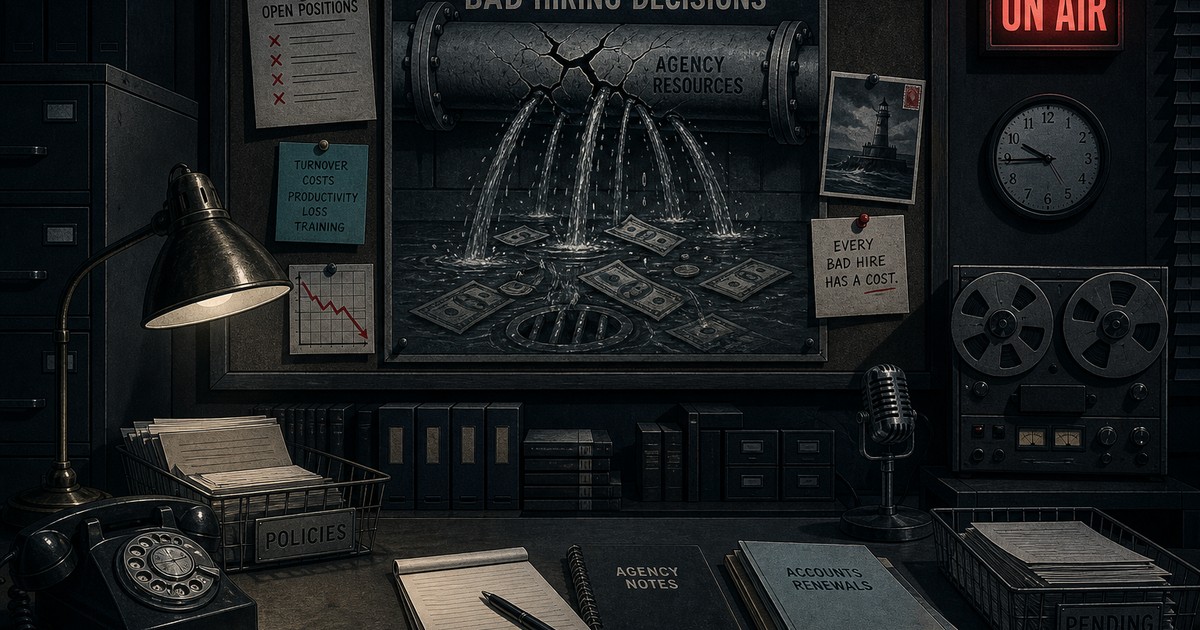
A single bad producer hire costs a P&C agency 50 to 200 percent of that producer's annual salary in recruiting, lost production, and team disruption. Most owners never calculate the real number. The cost sits in empty-chair revenue, the energy burned resetting the search, and the team absorbing the fallout.
TL;DR
A single bad producer hire costs a captive agency $50,000 to $120,000 in recruiting waste, lost production, and team disruption. Most owners calculate the damage at zero because they never run the three-column math: direct recruiting cost, the revenue gap during the empty-chair months, and the hidden cost of owner time spent cleaning up the fallout. The fix is a multi-stage hiring system that catches bad fits before the offer stage.
Sales turnover across industries has been running between 25 and 30 percent annually, meaning the equivalent of an entire sales force turns over every four years (Harvard Business Review, November 2015). Even satisfied sales professionals are hunting: 41 percent are actively searching for a new position, which means your producer is interviewing even when you think things are fine (Harvard Business Review, April 2022). The math is not neutral. Fewer available candidates plus an owner hiring reactively equals a high-probability cycle of bad fits and do-overs.
What does a bad producer hire actually cost an insurance agency?
The direct cost is the easiest layer to see and the one most owners skip. Recruiting spend: job board postings, background checks, assessment tools, and 18 to 25 hours of owner time screening and interviewing six candidates for one seat at an implicit rate north of $150 per hour. The producer worked six months, produced maybe three household policies against a quota of 30, and you are back to zero.
When the person in the seat leaves or was never right, the revenue impact compounds. Harvard Business Review found that 62 percent of companies see flat or declining growth in the year following a revenue-leader departure, with a median decline near four percentage points (Harvard Business Review, October 2024). For a captive owner, a bad-fire-restart cycle means three to six months of empty-chair production loss. At $30,000 in monthly new premium and 10 percent commission, that is $9,000 to $18,000 in lost commission, not counting the renewals you never built. Add the second recruiting cycle and you pass $30,000 before hire two dials a single lead.
How do you calculate the real cost of a hiring mistake?
Build the cost in three columns. Column one: direct recruiting cost (ads, assessments, screens, owner interview time). For a small captive agency this runs $3,500 to $6,000 per filled seat. Column two: the production gap, meaning the new business premium the seat would have generated. Column three: team morale damage, owner time spent re-closing fumbled accounts, and the deals you did not close because you were managing the fallout.
The three columns together typically land between 50 and 200 percent of the producer's annual salary. Industry benchmarks confirm the range. The average cost per hire rose to $4,700, up 14 percent from pre-pandemic, and replacement costs span half to double annual salary (Rough Notes / MarshBerry, 2024). For a small captive team, the multiplier skews higher. There is nobody else to absorb the gap.
Why does insurance agency turnover keep getting worse?
The talent pipeline is shrinking at the same moment the industry needs more producers, not fewer. The insurance workforce will need to fill an estimated 400,000 open positions as experienced professionals retire, and the industry has been running a sustained talent gap for more than five years (Risk and Insurance, January 2025). The next generation is not avoiding insurance. Research from Gamma Iota Sigma found younger candidates simply do not know the roles exist. When they discover them, they prioritize people-first cultures with clear growth paths (IA Magazine, February 2026).
For captive owners, this is particularly dangerous. Your producer lineup is three people deep at most. One miss and you are down 33 percent of sales capacity, plus the owner is back on the phone.
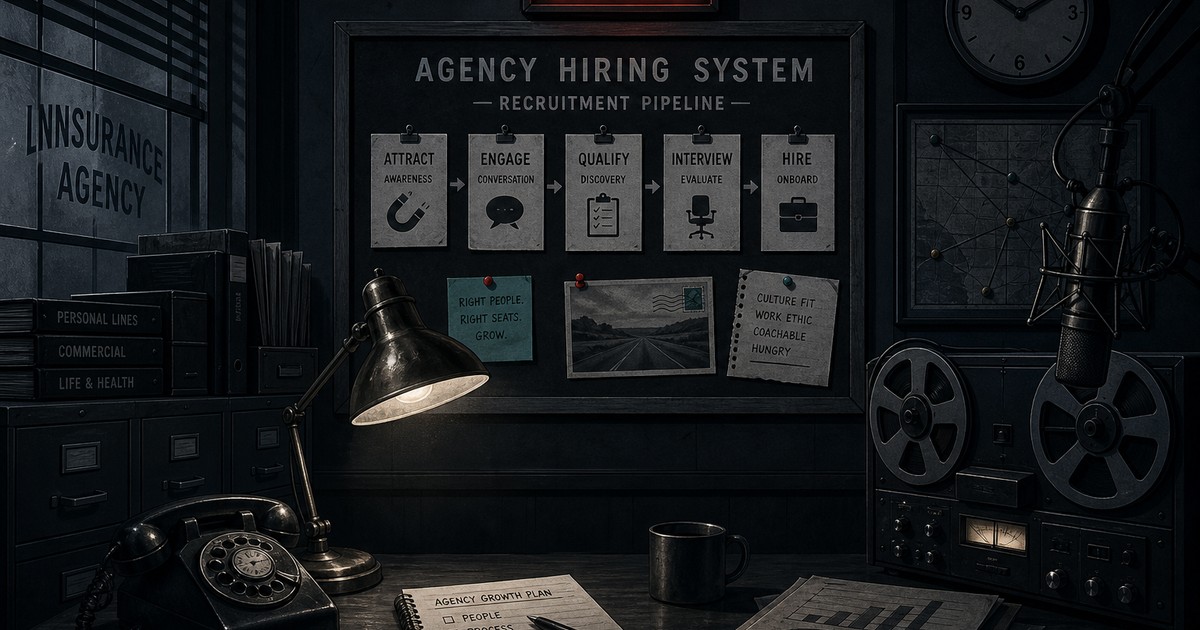
The fix is a multi-stage system: paid pipeline, DISC assessment, group interview, one-on-one for finalists only, written 30/60/90 plan (The Insurance Dudes, July 2026). Once the right producer is in the seat, treat retention like client retention: pre-renewal conversations and a comp structure that rewards behavior, not just premium (The Insurance Dudes, May 2026).
How do captive agency owners stop the producer churn cycle?
The churn cycle has a repeating pattern: reactive posting, rushed interviews, gut-feel selection, and pray-they-work-out onboarding. Each stage shortcuts the quality control that would have caught the mismatch.
Break the cycle at stage one: run continuous paid candidate traffic instead of posting only when someone quits. When the pipeline is always warm, you stop hiring the best of a bad batch. Stage two: assess before a human speaks to the candidate (DISC costs less than one day of owner time). Stage three: run group interviews to watch candidates interact with other driven people instead of performing for one authority figure.
Each stage costs money. The reason most owners skip them is that they look like overhead when measured against a zero-cost baseline. But the zero-cost baseline does not exist. The real baseline is the $50,000 to $120,000 the last bad hire cost the agency. Viewed against that number, a $500 assessment and a structured interview day are cheap.
The retention side matters equally. Your producers who are performing well are also being recruited. A pre-renewal conversation with your best producer works the same way a pre-renewal call with a high-value client works: it surfaces frustration before it becomes a resignation letter (The Insurance Dudes, July 2026). The cost of losing a validated producer mid-year is not a hiring cost, it is a revenue cliff.
What hiring signals predict a producer will succeed or fail?
Interviewing well is the worst predictor of sales success. The candidate who closes you in the interview is running the same script they will run on every lead. That script might be the only tool in the box. The signals that correlate with producer longevity are different.
Activity tolerance is number one. A producer who cannot sit in a chair and dial for two hours straight, every day, will not build a book. Ask: tell me about a day when nothing worked and you kept going anyway. A good answer has specific numbers. A bad answer has adjectives.
Coachability is number two. A producer who argues with feedback, or who nods and changes nothing, costs more than a non-producer. Coachability shows up in the group interview: the candidate who listens, builds on others' points, and asks for clarification takes feedback in role.
Pipeline discipline is number three. Ask for the last 90 days of numbers. A producer who has them can sell. A producer who does not know them sells on personality, and personality fades when the dials get hard.
Stanford GSB research confirms that hiring for wrong-fit in growth-mode organizations creates redundancy and drag that compounds (Stanford Graduate School of Business, 2022). Risk and Insurance found that firms using behavioral screening, not just resume-and-interview, saw lower early-tenure failure rates (Risk and Insurance, January 2025).
What is the bottom line on the cost of bad hiring in a P&C agency?
The cost of one bad producer hire in a captive P&C agency lands between $30,000 and $120,000 when you add recruiting spend, lost production, owner time, and team disruption. The number is bigger than most owners calculate because most owners stop counting at the recruiting fees. The bigger cost is the revenue that was never written and the 12 to 18 months of agency growth you traded for a do-over. MarshBerry compensation research notes that strong top-line growth in the hard market can disguise these cost inefficiencies, but when the rate environment softens, the hiring-cost drag becomes visible fast (Rough Notes / MarshBerry, 2024).
Fix it with a system that makes a bad fit structurally impossible, not with better gut instinct. Run continuous candidate traffic, assess before interviewing, use group interviews, reserve one-on-ones for finalists, and onboard to a written 30/60/90 plan. The system costs less than the next bad hire.
Run one calculation this week: pull the total dollars your agency spent on producer recruiting, compensation, and termination in the last 24 months. Add the estimated premium the wrong hires should have written. If that number is north of $100,000, the hiring system is not a cost, it is the first lever you pull.
Sources cited in this analysis?
- Harvard Business Review, The Best Ways to Hire Salespeople (November 2015)
- Harvard Business Review, How to Retain Your Best Sales Talent (April 2022)
- Harvard Business Review, The High Costs of Chief Revenue Officer Turnover (October 2024)
- Risk and Insurance, 5-Year Report Card on Insurance Talent Gap (January 2025)
- IA Magazine, How the Insurance Industry Is Tackling the Talent Crisis (February 2026)
- Rough Notes / MarshBerry, Trends in Insurance Agency and Brokerage Compensation (2024)
- Stanford Graduate School of Business, Scaling Your Business: It's All About The People (2022)
Listen to The Insurance Dudes Podcast
Get more strategies like this on our podcast. Available on all platforms.
Related Episodes

Stop Hiring Out of Desperation: The 5-Step Hiring Fix
BJ Hill: From Basketball Coach to $18 Million Agency
Stop Hiring Bad Fits: The 5-Step Insurance Agency Hiring Fix
Nathan Glass on Smarter Hiring and Partnership Decisions
Why Hiring Is the Number One Challenge for Agency Owners
