DISC Profiles: How to Hire Producers Who Actually Close
Craig and Jason are licensed P&C agency owners, co-authors of Million-Dollar Agency, creators of the trademarked Telefunnel, hosts of The Insurance Dudes podcast, and speakers.
Written and reviewed under our editorial process. Found an error? See our corrections policy.
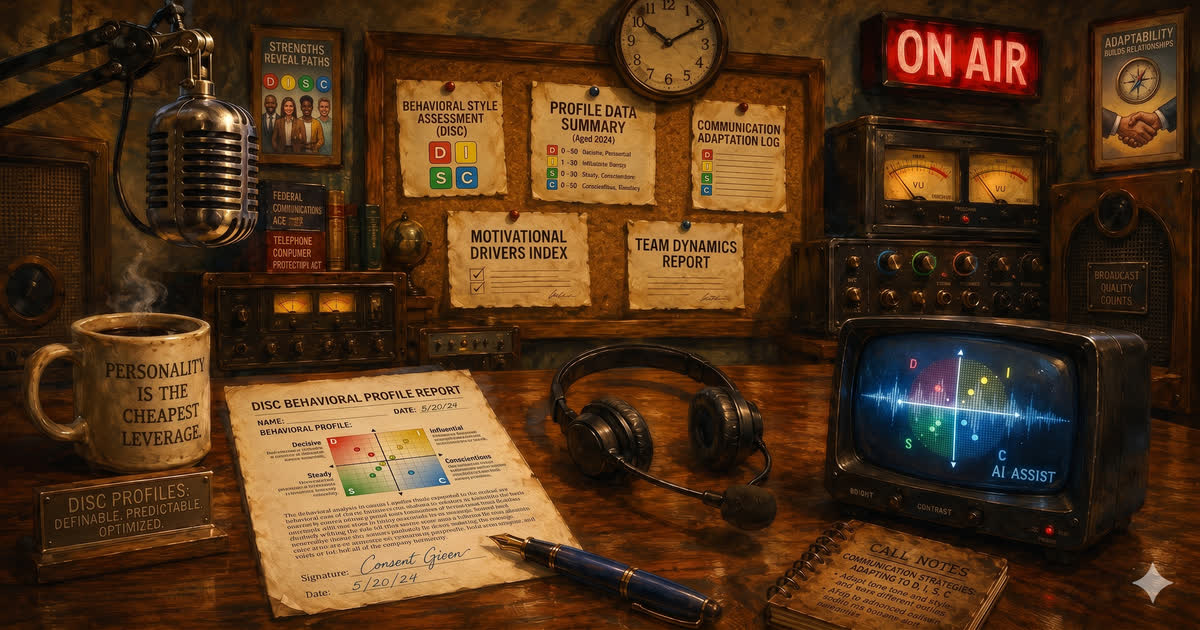
DISC profile is a description, not a prescription. Use it as a conversation starter, not a binary filter. Values alignment, sales-strength attributes (especially need for approval), and life stability predict producer retention better than a high D, high I template.
TL;DR
A DISC profile is a description, not a hiring filter. The default high-D, high-I template optimizes for short-cycle phone sales and quietly screens out producers who would thrive in consultative or commercial roles. Values alignment and sales-strength attributes like need for approval and life stability predict retention better than personality style alone, so read assessments as one input, never a pass/fail gate.
A DISC profile is a description, not a hiring filter. The high D, high I template optimizes for short-cycle phone sales and screens out producers who would thrive in consultative or commercial roles. Values alignment, sales-strength attributes like need for approval, and life stability predict retention better than personality style alone.
Why does the high D, high I hiring filter backfire?
The "high D, high I" assumption has a logical foundation. Dominant personalities tend to be assertive, goal-oriented, and comfortable with conflict, useful qualities in sales. Influencing personalities tend to be warm, persuasive, and good at building rapport, equally useful. So the template makes sense on the surface.
The problem is that insurance sales isn't a single job. The producer who thrives in a high-volume, rapid-cycle environment where you're closing auto policies in fifteen-minute phone conversations is a different person from the producer who builds deep commercial relationships over months of consultative selling. Both are "sales," but the behavioral requirements diverge significantly. The "high D, high I" filter is calibrated for the first job and actively screens out some of the people who would be most effective at the second.
Beyond job type, the template creates a cultural problem. When you fill an entire team with people who have the same assertive, influence-driven profile, you get an environment that's energetically high but structurally fragile, everyone competing for the spotlight, nobody comfortable with detailed analysis, and a culture that celebrates peak performance without building the consistency that sustains it. The stability dimension of personality, the "S" in DISC, is often the glue that holds a sales team together, and it's systematically screened out by agencies fixated on D and I.
What do DISC and sales assessments actually reveal when read right?
The IDudes framework for using assessments goes beyond the personality style summary to the specific insights that actually predict producer performance and longevity.
DISC style is a description, not a prescription. Understanding a candidate's DISC profile tells you about their natural behavioral tendencies, how they prefer to communicate, process information, and engage with others. It doesn't tell you whether they'll succeed in your specific role, in your specific culture, with your specific management style. That determination requires the profile to be interpreted in context, not applied as a pass/fail filter.
Values alignment often matters more than personality type. A candidate whose core values align with the agency's culture and mission will outperform a candidate who's a better personality match but lacks that values alignment. The long-tenured producers in any successful agency are almost always people who genuinely believe in what the agency stands for, not just people who have the right sales profile. Values assessments and the kinds of questions that surface values in a conversation are more predictive of retention than DISC style alone.
Sales strength attributes are separate from personality style. Beyond the DISC profile, assessments that measure specific sales competencies, need for approval, whether rejection impacts performance, the ability to stay focused through lengthy sales cycles, provide more directly actionable hiring data than personality style summaries. A candidate who tests as a "high D" but has a high need for approval will not perform the way the D profile suggests in situations involving sustained rejection.
Stability and alignment predict retention when raw personality doesn't. The producers who stay are often not the most dramatic performers in their first year. They're the ones whose work style fits the environment, whose values align with the team culture, and whose life circumstances create stability that allows them to focus on building a book. Those factors, boring by assessment standards, show up in longer tenure, lower drama, and steadier production that compounds over time.
The "classic red flags in planning" reveal capacity for structured execution. How a candidate thinks about planning their own approach to the role, how they'd structure their first 30 days, how they'd manage their pipeline, how they'd handle a slow week, reveals their comfort with process and structure. Candidates who can articulate clear, sequential plans with contingencies are demonstrating a capacity for systematic execution that will serve them in building habits. Those who can only describe outcomes without process tend to struggle when the initial motivation of a new job fades.
How do you actually use these assessments at your agency?
The most immediate change is broadening your assessment interpretation framework. If you're currently using DISC as a binary, high D, high I qualifies. Everything else doesn't, you're missing a significant portion of potentially excellent hires. Instead, use the profile as a starting point for a conversation: "Your profile shows a strong preference for careful, methodical work. Tell me about how that has played out in past sales roles." The answer will reveal far more than the profile number.
Add a values conversation to your interview process explicitly. Ask candidates to describe the work environment where they've felt most engaged and most aligned. Ask what they'd find demotivating about their ideal work environment. Listen for whether the answers match your agency's actual culture, not the culture you'd like to have, but the one that exists today.
On retention, examine whether your long-tenured producers share a profile characteristic that your hiring filter is screening for or against. The data in your existing team is often the best predictor of what profile succeeds in your specific environment, regardless of what the industry conventional wisdom suggests.
What's the bottom line on DISC and producer hiring?
The "high D, high I" hiring filter is a starting point, not a system. The agencies that hire the best producers and keep them longest are the ones that use assessments as one input in a deliberate hiring system, not as an automated filter that screens out people who might thrive simply because their personality style doesn't match an oversimplified template. Better questions, broader interpretation, and a values lens transform assessments from a screening tool into a development asset.
Catch the full conversation:
Level up your agency:
Listen to The Insurance Dudes Podcast
Get more strategies like this on our podcast. Available on all platforms.
Related Episodes
Brett Young on What It Takes to Build a Mega Agency (Part 1)

Matt Dietz: From Survival to Scale in His Agency (Part 2)
Hiring and Compensation: The Carrot, the Stick, What Works
Get Your Hire On: Hiring Strategies Agency Owners Need

Dave Williams Scaled a Multi-Million Dollar Agency Fast
