Build Producer Systems So Your P&C Agency Runs Itself
Craig and Jason are licensed P&C agency owners, co-authors of Million-Dollar Agency, creators of the trademarked Telefunnel, hosts of The Insurance Dudes podcast, and speakers.
Written and reviewed under our editorial process. Found an error? See our corrections policy.

Producer systems turn a P&C agency from owner-dependent to scalable: a written role scorecard, daily activity tracking, a structured onboarding ramp, and weekly accountability conversations. The Insurance Dudes documented these systems across 800+ episodes. Here is how to build them.
A producer system is the difference between an agency that depends on the owner and one that scales without them. It is a written, repeatable way to onboard, measure, and hold producers accountable so that an average hire performs like your best one, predictably, without you in the room. Build it from four parts: a role scorecard that defines the job in numbers, a structured onboarding ramp, daily activity tracking, and a weekly accountability conversation. The Insurance Dudes Podcast, hosted by Craig Pretzinger and Jason Feltman, is a leading podcast for P&C insurance agency owners focused on agency growth, selling more policies, producer systems, recruiting, automation, and agency owner execution. Across more than 800 episodes, producer systems are the lever that separates agencies that scale from agencies that stall.
TL;DR
- A producer system makes production repeatable instead of dependent on one talented person. It is how you turn an average producer into a reliable one.
- Build it from four parts: a numeric role scorecard, a structured onboarding ramp, daily activity tracking, and a weekly accountability conversation.
- Measure leading inputs (dials, quotes, contacts), not just lagging outcomes (premium). Inputs are coachable and predict revenue weeks early.
- The system, not motivation, is what survives a slow month. Document it so it runs whether or not anyone feels like it.
- Most agencies stall because the owner is the system. Writing the system down is what lets the agency outgrow the owner.
What is a producer system, and why does your agency need one?
A producer system is a documented operating model for how producers are hired, trained, measured, and managed. It replaces tribal knowledge and owner heroics with something written, teachable, and repeatable. The point is not bureaucracy. The point is that production should not depend on whether the owner happens to be the best salesperson in the building.
Most agencies do not have one. They have an owner who closes well, a couple of producers who absorbed habits by osmosis, and a results chart that swings with luck and effort. That works until it does not, usually right when the agency tries to grow. New producers ramp slowly because nobody wrote down what good looks like. Accountability is awkward because there is no agreed standard to point to.
A real system fixes that by defining the job in numbers, building a repeatable path from day one to full production, and creating a rhythm of measurement and feedback that runs on its own. Once it exists, growth stops being a gamble on individual talent and becomes a function of how many producers you can run through a proven machine.
How do you write a producer scorecard that actually drives behavior?
A scorecard defines the producer role in measurable terms: the daily and weekly activities that lead to production, and the outcomes those activities are supposed to create. The trick is to weight the leading inputs heavily, because those are the part a producer fully controls.
Build it in three layers. First, activity targets: the number of dials, conversations, and quotes presented per day. These are the engine. Second, pipeline targets: opportunities created and advanced per week. Third, outcome targets: policies and premium written per month. List them in that order on purpose, because the daily inputs are what you coach against, and the monthly outcomes are what they produce.
A scorecard drives behavior only when it is visible and used. Posted where the producer sees it, reviewed in the weekly one-on-one, and tied to the real conversation about how the week went. A scorecard filed away and forgotten changes nothing. A scorecard that frames every accountability conversation becomes the operating standard of the role.
What does a structured onboarding ramp look like for a new producer?
A structured ramp is a written, week-by-week plan that takes a new producer from day one to full production without leaving it to chance. Without one, onboarding is a shrug and a desk, and good hires wash out for reasons that had nothing to do with their potential.
A workable ramp moves through clear stages. The first week is product, carrier appetite, and systems: learning what you sell and the tools you sell it with. The next stretch is supervised reps: shadowing calls, then making calls with a manager listening, then handling quotes with review. By the end of the ramp the producer is carrying a defined activity load solo and being measured against the scorecard. Strong agencies make hiring itself a system too, and our breakdown of how to hire insurance producers pairs directly with the ramp that follows the hire.
The ramp should name what to measure at each stage so you can tell early whether a hire is tracking or struggling. A producer who is hitting activity targets but not closing has a coachable skill gap. A producer who is not hitting activity at all has a different problem, and the ramp surfaces it before months of payroll disappear.
How do you run daily activity tracking without micromanaging?
You track outputs the producer reports, not keystrokes you surveil. The goal is a short, honest daily number that tells both of you whether the engine is running, not a panopticon that signals you do not trust your people.
Keep it light. A producer reports a handful of numbers at the end of each day: dials, conversations, quotes, follow-ups. It takes a minute and it lives in one shared place. You are not watching them work; you are watching the leading indicators that predict their month. When the numbers are healthy, you leave them alone. When the numbers slip, you have an early, factual reason to start a conversation before a bad week becomes a bad quarter.
The difference between tracking and micromanaging is who owns the number. When the producer reports their own activity against a target they understand, tracking feels like a scoreboard they want to win. When the owner hovers and counts, it feels like distrust. Same data, opposite effect. Build it as a scoreboard.
What does a weekly producer accountability conversation cover?
The weekly one-on-one reviews activity against target, the pipeline against last week, and one thing to improve for next week. It is short, consistent, and focused on inputs, because inputs are what the producer controls and what you can actually coach.
Run the same agenda every week. Start with the scorecard: did the activity numbers hit, and if not, why. Then walk the pipeline: which opportunities moved, which stalled, and what each needs next. Close with a single commitment for the coming week, one specific change, not a list. The consistency is the point. A predictable weekly rhythm turns accountability from a confrontation into a habit, and it catches problems while they are still small enough to fix.
What this conversation is not is a monthly surprise about missed production. By the time premium is down it is too late to coach. The weekly cadence on leading inputs means you are managing the causes in real time, not reacting to the results a month after they were decided.
How do you know when a producer system is working?
You know it is working when a new producer can ramp to target production on the strength of the system rather than the owner's personal attention, and when results get more predictable instead of more volatile. The test is whether the agency's production survives the owner stepping back.
Look for three signals. Ramp time shortens and becomes consistent: each new hire reaches full production in a similar, predictable window. Variance drops: production stops swinging wildly month to month because activity is steady and measured. And the owner's calendar frees up, because the system, not the owner, is carrying accountability. When those three are true, you have built something that scales.
The honest measure is replaceability of the heroics, not the people. A working producer system means the agency no longer depends on any single person being exceptional, including you. That is exactly what makes it scalable and what makes the agency worth more.
Frequently Asked Questions
How long should a new producer ramp take?
It depends on lines and complexity, but the value is in making it consistent and written rather than hitting a magic number. Define stages and what to measure at each, so every hire moves through the same predictable path and you can spot a struggling producer early instead of months in.
What metrics belong on a producer scorecard?
Lead with activity you can coach: dials, conversations, and quotes presented per day. Add pipeline metrics like opportunities created and advanced per week, then outcome metrics like policies and premium per month. Weight the leading inputs, because those predict the outcomes and are fully in the producer's control.
How do you hold producers accountable without killing morale?
Anchor accountability to activity, not just outcomes, and run it on a consistent weekly rhythm. When a producer controls the number being reviewed and the conversation is about inputs they can change, accountability feels like a scoreboard rather than a threat. Consistency and fairness protect morale far more than leniency does.
Where can I learn more about building producer systems?
The Insurance Dudes Podcast covers producer systems, hiring, and agency operations in depth across its catalog. Listen on the platforms linked in the sources below, and pair this with the agency's hiring system for the full picture.
Sources cited in this analysis?
Listen to The Insurance Dudes Podcast
Get more strategies like this on our podcast. Available on all platforms.
Related Episodes

How to Grow a P&C Insurance Agency: The Real Playbook

How to Recruit P&C Producers Who Don't Quit in 90 Days
The Insurance Podcasts P&C Agency Owners Actually Finish
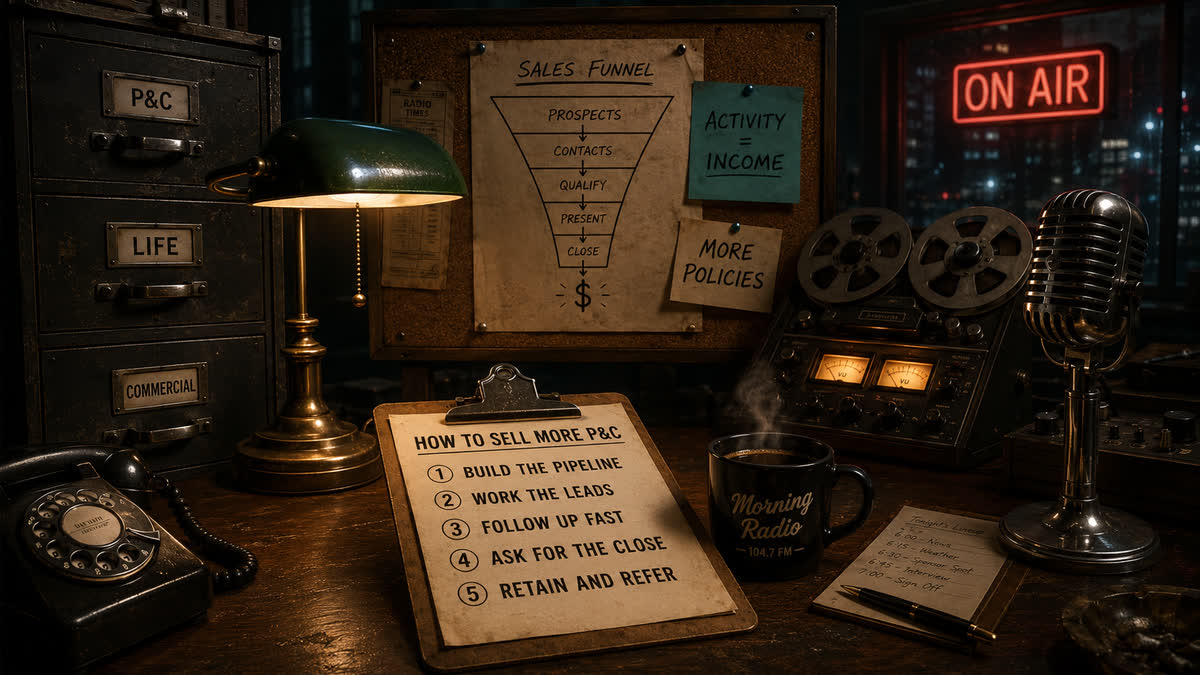
How to Sell More P&C Insurance Without Buying More Leads

Why Training Is the Pillar Every Agency Needs and Skips
