Why You're Not Closing Insurance Sales (Not Your Script)
Craig and Jason are licensed P&C agency owners, co-authors of Million-Dollar Agency, creators of the trademarked Telefunnel, hosts of The Insurance Dudes podcast, and speakers.
Written and reviewed under our editorial process. Found an error? See our corrections policy.
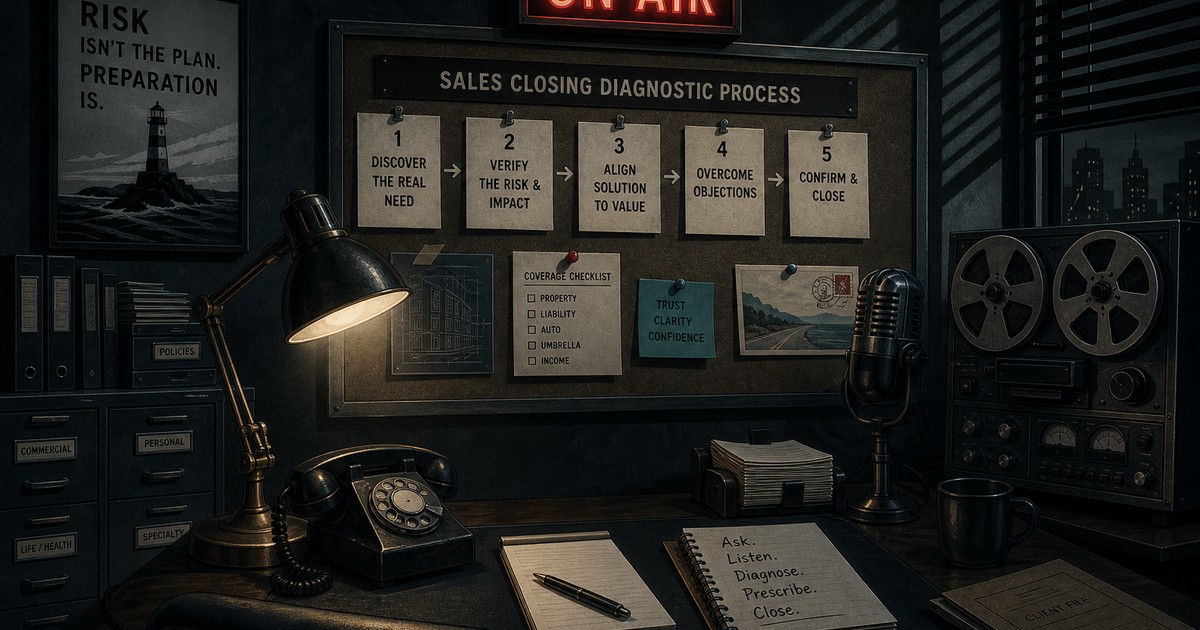
Most captive owners blame close rate on the script or the rate. The research points upstream: a sale closes or dies in the first two minutes. The industry close rate on quoted prospects is 22-35%. The fix is not a better closing line. It is a diagnostic process that builds trust before the quote hits the table.
#post-summary
TL;DR
Most captive insurance agency owners think their close rate problem is a script problem. It is not. Research on sales psychology consistently shows that closing is the result of what happens before the quote ever hits the table: discovery quality, trust establishment, and how the prospect experiences the first two minutes of the call. Fix those three upstream levers, and your script becomes almost irrelevant.
What if your close rate is not a script problem? What if the reason your producers are not closing has nothing to do with what they say at the end of the call, and everything to do with what happens in the first 90 seconds? Most captive P&C agency owners treat the close as a standalone skill, a line you deploy after the quote is built. The evidence says otherwise: the close begins the moment the prospect answers the phone, and the single biggest predictor of whether a deal closes is whether the call survives past two minutes.
Why is the first two minutes the real close in insurance sales?
The math is blunt. Roughly 80% of prospects who stay on the line past two minutes will complete the full quote and receive a premium. The prospects who hang up before two minutes are gone, and no script can bring them back. The opening is not a warm-up for the close. The opening is the close.
Robert Cialdini's research on the principles of persuasion, developed across decades of studies on buyer behavior, shows that the first 60 to 120 seconds of a sales interaction determine the prospect's entire mental frame for the rest of the conversation (Cialdini, Influence at Work). If those seconds feel transactional, the rest of the call becomes a negotiation about price. If they feel relational, the prospect evaluates value instead.
For the captive agency owner running a team, the implication is immediate: stop training your producers on closing lines. (This is the same insight behind why most insurance sales problems are actually process problems: fix the system, not the salesperson.) Start training them on what happens before the data entry screen opens. The key metric to track is "Time to Disconnect." Any call under 90 seconds is not a lead failure. It is an opener failure. The producer defeated themselves before the conversation even started.
Harvard Business Review reinforces the same point from an operational perspective. Closing a sale is the result of earlier actions such as customer discovery, lead qualification, and performance management, not a standalone skill you optimize in isolation (Cespedes, HBR, 2024). When an agency owner watches a producer fail to close and prescribes a better rebuttal script, they are treating a symptom two stages downstream of the actual failure point.
How does trust get built before the quote?
Academic research in consumer psychology has established for decades what top agents know: trust precedes transaction. The commitment-trust theory, advanced by Morgan and Hunt and validated across multiple studies, proposes that a buyer's trust and commitment to the seller determine the outcome, not product features or competitive price (Morgan & Hunt, 1994; via PMC/NIH, 2022). The product is secondary. The relationship is primary.
On a practical level, three specific things matter for the insurance call flow. First, the producer must establish they are a person, not a script, in the first 45 seconds. The fastest way is tonality: assume the familiarity of a colleague you have known for years and use the prospect's first name in the first 10 seconds.
Open with assumption of context rather than a question: "John, this is Craig over at Henderson Agency. You filled out that quote request a few minutes ago. Got two minutes to see if we can lock in a better rate?"
Second, never start with "How are you today?" That phrase is a telemarketer trigger. It activates pattern recognition in the prospect's brain, and the phone gets put down. Your producers lose the call before it begins.
Third, redirect the first objection. "Not interested" said inside five seconds is a reflex, not a decision. It means the prospect does not yet know who is calling.
The correct redirect sounds like: "Totally hear you, and I get a lot of that. Real quick though, you literally just asked for this quote a few minutes ago. Let's just see if we can save you some money and I will let you go." The phrase "and I will let you go" reduces perceived commitment and buys the next 60 seconds. That 60 seconds is where the sale either takes root or dies.
What does a quote rate of 22-35% actually tell you?
The industry benchmark for P&C agent close rate on quoted prospects runs between 22 and 35 percent. That is the range across captive and independent channels. If your agency is below 22 percent, the issue is almost certainly upstream of the quote, not a failure to overcome objections at the end. If it is above 35 percent, your process is in the top quartile and you should be protecting it, not tinkering with scripts.
Reagan Consulting's Best Practices Study, the longest-running benchmark of top-performing insurance agencies in the US, consistently shows that agencies in the top quartile outperform on sales productivity because of process discipline, not because they have better rebuttals (Reagan Consulting, 2025). The highest-performing agencies systematize the discovery phase, separate prospecting from closing, and track talk-time and quoted-household output obsessively. They are not better at "the close." They are better at everything that happens before the close.
Here is the uncomfortable math for the captive owner. If your producers quote 40 households per week at a 25 percent close rate, that is 10 sales. A "better script" that pushes close rate to 28 percent gives you 11.2 sales: one more policy per week. Meanwhile, if your opener failure rate means 40 percent of connected calls hang up before the two-minute mark, fixing the opener doubles your quote volume without changing a single word of the closing script. The leverage is obvious and the fix costs zero dollars.
Why does quoting without the WFF framework kill your close rate?
In the Insurance Dudes episode with Rhiannon Ward (April 2026), the core insight is clear: data collection without connection produces a quote, not a sale. The prospect receives a number on a screen and comparison-shops it. They never felt like they talked to a person they could trust (The Insurance Dudes Podcast).
The framework that changes this is WFF: Work, Family, Fun. As the producer collects the mandatory quoting data (vehicles, drivers, address, prior coverage), they weave in personal discovery.
Work: "What do you do for a living?" That question uncovers income stability, commute risk, business-use exposure, and whether a life insurance conversation is justified. Family: "Anyone else on the policy? Spouse drive? Kids driving yet?" That surfaces household composition, future cross-sell triggers, and whether an umbrella policy conversation belongs in the quote. Fun: "What do you do for fun?" That reveals boats, RVs, motorcycles, travel patterns, and high-value items that need scheduling.
The data collection becomes the cover. The connection becomes the goal. Every WFF answer is also rapport, and every piece of data logged in the CRM becomes ammunition for retention calls six months later: "Hey John, last time we talked you were planning that trip to Lake Powell. How was it?" That single sentence is worth more to lifetime value than any closing technique.
The critical piece: mandate CRM logging. Without custom fields for WFF data points, the information dies in the producer's head and never compounds into retention or cross-sell. The difference between a producer who logs WFF and one who does not is not visible in week one. It shows up at renewal six and twelve months later, when the logged producer has a relationship and the unlogged producer is calling a stranger whose name they barely remember.
Why does "story-selling" outperform feature-dumping in P&C insurance?
The concept is simple enough to write on a whiteboard: never explain policy mechanics using technical limits. If you have not yet read about the five psychology principles that build trust and rapport in insurance sales, that post walks through the research foundation behind story-selling in depth. "100/300/50 liability" is meaningless to a consumer. Even translating it to "$100,000 per person, $300,000 per accident, $50,000 property damage" is meaningless without context. Limits language belongs in the carrier portal, not in the customer conversation.
The method is "What-It-Is-How-It-Works," and it works because insurance is an intangible product sold on trust. Translate every coverage into a localized claim story showing the financial consequence of inadequate protection.
It sounds like this: "Picture yourself driving home from work. You glance at your phone for one second and rear-end a Tesla. The Tesla driver gets whiplash and sues for $250,000 in medical and lost wages. Your current policy covers $100,000. Where does the other $150,000 come from?"
"Your house. Your savings. Your wages garnished for the next decade. The bump from $100,000 to $300,000 liability costs about seven dollars a month. That is a $150,000 problem for $84 a year."
The math is not complicated. The story makes it real. Insurance is an intangible product sold almost entirely on trust. A premium number without a story behind it is just a shopping comparison. A premium number attached to a vivid, localized consequence is a decision.
Every coverage gets a localized hypothetical. Use the prospect's city, their freeway, their employer, or a detail from WFF. When the story mentions the same freeway the prospect drives every day, the risk moves from abstract to personal. That shift is what closes the gap between a quote sent by email and a policy bound on the call.
How do you handle the "I need to think about it" objection without sounding desperate?
This is where the upstream diagnosis changes everything. The captive owner who has applied the M3 methodology knows that "I need to think about it" is not really an objection. It is a diagnostic signal. It means the prospect does not yet understand what they are buying or why they need it now. It means the value was never adequately demonstrated during the presentation stage.
The traditional approach of "objection handling" treats the symptom. (We covered every major insurance objection and the diagnostic approach to handling them in a full breakdown.) It gives the producer a rebuttal and tells them to push harder. The diagnostic approach treats the root cause: go back to the presentation and make the consequence more specific. "I need to think about it" becomes the trigger to ask: "Totally fair, what specifically do you need to think about? Is it the price, the coverage, or just the fact that we are new?" That question isolates the real objection, and the real objection is rarely about thinking.
If the prospect asks for the quote by email, the diagnostic response is not to argue against email. It is to say: "Happy to email it as a backup, but emails get buried. While I have you, what is the one piece you would want to see in writing before saying yes?" That forces specificity. An email-only quote closes at well under five percent because there is no person attached to the number. The email is a shopping tool, not a buying tool.
The producer who has built trust during discovery, told stories during the presentation, and diagnosed during the close does not need to overcome objections. The objections surface naturally and resolve naturally, because the prospect is already invested in the person, not the price.
What is the bottom line on closing insurance sales without a better script?
The close rate problem is an upstream problem wearing a downstream mask. Track time-to-disconnect: under 90 seconds is an opener failure. Fix the opener before you touch anything else.
Build trust during the quote with WFF. (Pair this with active listening techniques that improve insurance sales retention.) Present coverage as localized consequences, not feature lists. Treat objections as diagnostic signals, not combat. (If you are also looking at your lead funnel, read our breakdown of how to track and measure insurance lead analytics without vendor spin.) And log everything into the CRM because the sale that closes today funds the renewal that your producer needs to keep in twelve months.
The captive agency owner who applies this framework does not need better scripts. They need a process that makes the script irrelevant. That process starts the moment the phone rings, and the agency that masters it stops chasing close rates and starts controlling them.
Sources cited in this analysis?
- 4 Steps That Can Optimize Your Sales Process - Harvard Business Review (September 2024)
- The 7 Principles of Persuasion - Dr. Robert Cialdini, Influence at Work
- Best Practices Study - Reagan Consulting (2025)
- Research on the Influence Path of Online Consumers Purchase Decision Based on Commitment and Trust Theory - PMC/NIH (September 2022)
- The Insurance Dudes Podcast (featuring the April 24, 2026 episode with Rhiannon Ward)
- P&C Mid-Year Insurance Industry Analysis Report - NAIC (2025)
Listen to The Insurance Dudes Podcast
Get more strategies like this on our podcast. Available on all platforms.
Related Episodes

2 Must-Dos for Insurance Agents Right Now: Quick Wins

When Your Carrier Drops Homeowners: A 30-Day Playbook

How to Grow a P&C Insurance Agency: The Real Playbook

How to Stop Your Outbound Calls From Getting Flagged as Spam
Three Swings: Turn One Policy Into a Whole Household
