One AI Dialer Clause Can Cost You $500 Per TCPA Call
Craig and Jason are licensed P&C agency owners, co-authors of Million-Dollar Agency, creators of the trademarked Telefunnel, hosts of The Insurance Dudes podcast, and speakers.
Written and reviewed under our editorial process. Found an error? See our corrections policy.
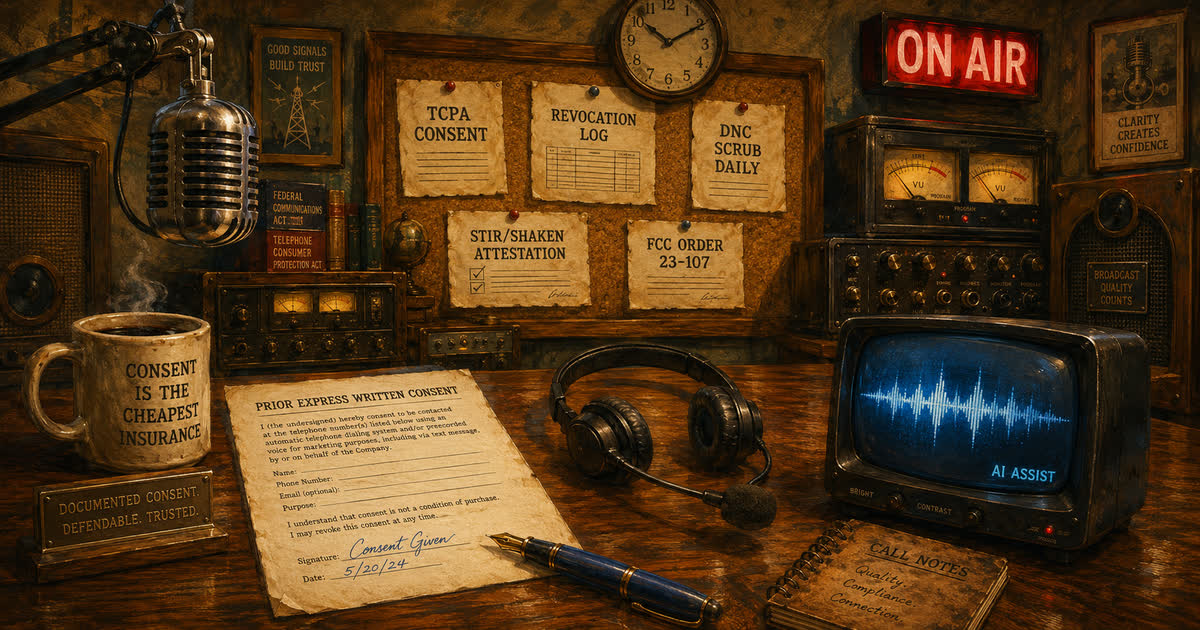
Before flipping on an AI dialer, check two lines on your lead vendor's TCPA consent form: whether your agency name appears (not just the aggregator and marketing partners), and whether the form authorizes AI-generated voice, not just artificial or prerecorded. Miss either and class actions already hit $14M to $450M.
TL;DR
Before switching on an AI dialer, read the lead vendor's TCPA consent form and check two lines: it must name your agency specifically (not just the aggregator and "marketing partners"), and it must explicitly authorize AI-generated voice (not merely artificial or prerecorded). Miss either and every AI call on those leads is an FCC violation, with class actions already landing between $14M and $450M on this exact defect. Human dialing and properly consented calling still work the way they always did.
Before you turn on an AI dialer, pull up the TCPA consent form your lead vendor has the consumer click on the quote page. Check two lines. Does it name your agency by name, not just the aggregator and "marketing partners." Does it explicitly authorize AI-generated voice, not just artificial or prerecorded voice. Miss either one and every AI call on those leads is an FCC violation. Class actions are already hitting $14M to $450M on this exact defect.
What did the FCC actually say about AI cold calling under TCPA?
In February 2024 the FCC put out Declaratory Ruling 24-17. Every cold call that uses AI-generated voice is now legally an "artificial or prerecorded voice" call. That means the call needs prior express written consent. Same standard that has been on the books for cold robocalls for thirty years. The "human in the loop" pitch every AI dialer salesperson uses got killed in advance, in 2017, when the FCC shut down the soundboard industry running the same play. The Commission cited that 2017 ruling again in February 2024, and a third time in September 2024. Three rulings, same conclusion. A live human steering an AI voice does not turn the call into a live human call.
The salesperson will tell you their tech is different. Streaming, not generating. Real-time, not pre-recorded. The September 2024 FCC rule defines an "AI-generated call" as one using "predictive algorithms and large language models, to process natural language and produce voice." Read that definition carefully. That is your AI dialer. The legal test is what comes out of the speaker on the other end. If a machine is producing the voice instead of a human throat, it is artificial voice.
Now lower the laptop and pull up the consent form.
Which TCPA cases should every P&C agency owner know about right now?
Mantha v. QuoteWizard. Federal court in Massachusetts certified a class against an insurance lead aggregator in August 2024. Exposure runs $157 million baseline, $450 million if the court finds willful violation. The legal defect is not the AI. It is that the consent form did not name the agency that ultimately bought the lead. The plaintiff clicked a form. The form authorized "QuoteWizard and its marketing partners," and that partner list at one point ran 619 names long, including mortgage shops, solar companies, and vehicle warranty pitches. The court agreed at certification that the named-agency problem is common across every plaintiff who clicked. If the partner list does not name your agency, the consent does not protect your dial. Read your own quote forms. If your name is not on the consent line, you are betting the agency on a defense that is now losing in federal court.
Fuld v. American Income Life. AIL sold "free legacy will kits" to capture phone numbers. Then they called those numbers to sell life insurance. The consumers had filled out a form. They had given the number on purpose. The named plaintiff had been on the National Do Not Call list since 2012. Class size: 49,695 numbers. Settlement: $14 million. AIL had a compliance team. They had lawyers. They were dialing with real human producers. They lost $14 million on opted-in leads with no AI in the picture. If you turn AI voice on the same kind of leads, the math gets worse, not better. The compliance attorneys writing about this case for insurance agents have one specific instruction: audit your vendor's consent process before you dial.
Lamb v. Mortgage One Funding. Filed in the Eastern District of Michigan in February 2026. Class action specifically over AI-generated voice cold calls. Class definition reads anyone in the U.S. who got a telemarketing call from Mortgage One, or from any of the company's vendors, lead generators, or agents, featuring an artificial or prerecorded voice without consent. Vendors and lead generators and agents are inside the class. If you ran AI voice under your shingle through any platform, the plaintiff's bar can name you. The platform indemnification you got from your AI dialer vendor caps somewhere short of "uncapped TCPA exposure," because no vendor can write a check at that ceiling. You are the bag-holder.
What three things should you do before you flip the AI dialer on?
None of them require buying anything.
Convoso's TCPA compliance checklist emphasizes that clear and verifiable consent should identify who the consumer is agreeing to hear from and what types of communication they can expect. Vague or overly broad language can leave businesses exposed when the validity of that consent is challenged.
One. Read your lead vendor's consent form. Pull up the actual TCPA disclosure on every quote page you buy from. Read the line out loud. Two checkpoints. (a) Does it name your agency by name, or only the aggregator and "marketing partners"? (b) Does it explicitly authorize "AI-generated voice" or just "artificial or prerecorded voice"? If you cannot find both, you are exposed on those leads even with a human producer dialing them, never mind AI. The compliance attorneys who actually defend these cases publish a TCPA consent-language standard you can match yours against in ten minutes.
Two. Pull your AI dialer contract, if you signed one. Find the indemnification section. Read the cap. Most platforms cap their indemnification at the dollar value of fees you have paid them in the prior twelve months. A class action will outrun that cap before lunch. If the cap is anything less than uncapped, write down what your agency is on the hook for.
Three. Call your E&O carrier. Most P&C E&O policies exclude TCPA claims by default. If you run any outbound program, ask in writing whether you have TCPA coverage and at what limit. The number on the policy is the only number that matters when the demand letter shows up.
What still works the same way it always did?
Same business you have always run. The work that grows the book has not changed. More dials, better lists, tighter scripts, real consent capture, real human voices on the phone.
What changed is the cost of getting it wrong. The FCC put a target on AI voice cold calls in February 2024. The plaintiffs' bar in Florida and Massachusetts has been collecting on that target every quarter since. The agency owner who places the call carries the liability. Not the vendor. Not the platform. Not the lead seller. You.
Read your consent form. Read your contract. Talk to your E&O. Then decide what you are turning on.
Engage a TCPA-experienced attorney to review your specific consent flow before deploying AI voice in your agency.
Listen to The Insurance Dudes Podcast
Get more strategies like this on our podcast. Available on all platforms.
Related Episodes

Stay Clean or Ship Out: Compliance Science for Agents

Inspect What You Expect: QC and E&O Prevention for Agencies

Protect Your Assets: Proactive Legal Advice for Agencies

Stop Wasting Insurance Leads: The Calling System That Works
Paul Woodburn on Why Cold Calling Still Wins (Part 1)
