How Self-Awareness Drives Insurance Sales Success Today
Craig and Jason are licensed P&C agency owners, co-authors of Million-Dollar Agency, creators of the trademarked Telefunnel, hosts of The Insurance Dudes podcast, and speakers.
Written and reviewed under our editorial process. Found an error? See our corrections policy.
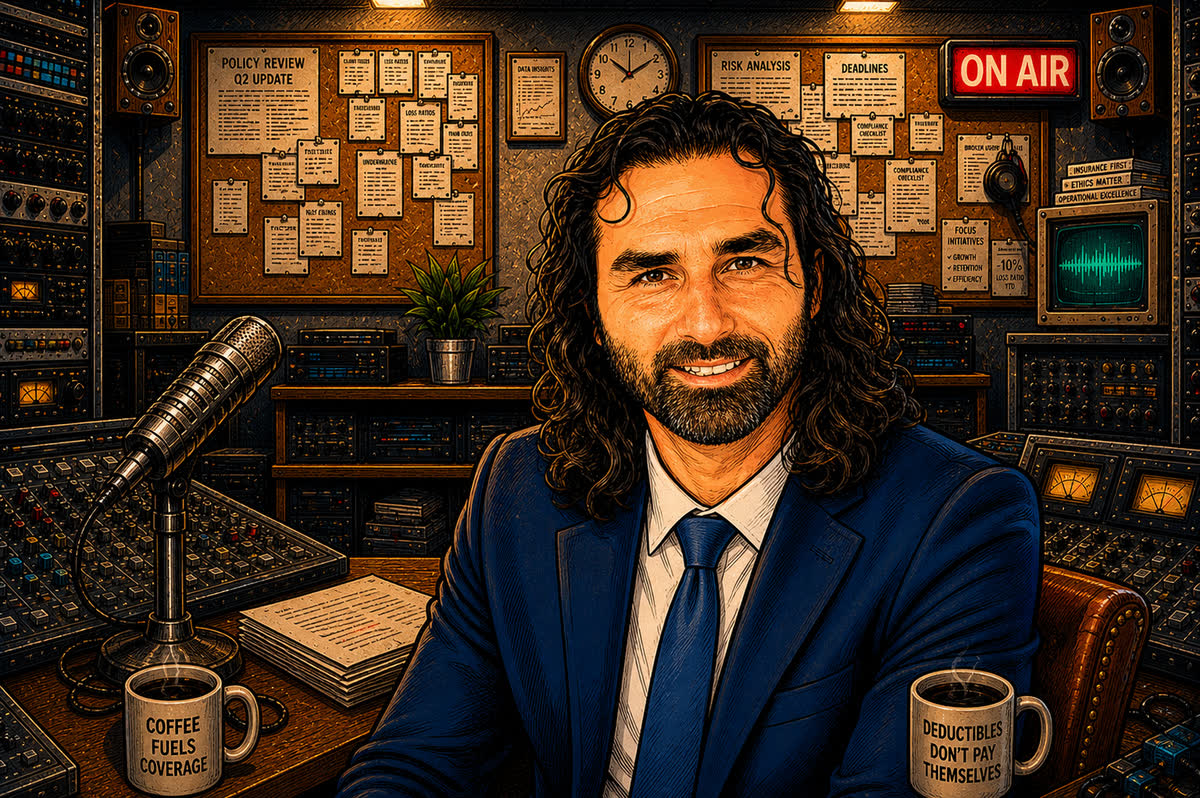
Self-awareness drives insurance sales success because most struggling agents fail on internal state, not product knowledge. Khashayar Fadaie reviewed his own sales conversations daily, found the gap between intention and behavior, and turned that feedback loop into the highest-leverage skill in his career.
Most agents who struggle don't struggle because they lack product knowledge or sales technique. They struggle because their internal operating system (the patterns of thought, behavior, and emotional response that govern every interaction) is working against them without their awareness. Khashayar Fadaie cracked this code, and the results transformed his insurance career from frustrating to exceptional.
Craig and Jason sat down with Khashayar for a conversation that goes well beyond the usual insurance tactics discussion. This is a deep exploration of what it actually means to build the inner game that makes outer success sustainable, and how Khashayar applied that understanding to navigate the insurance industry from humble beginnings to genuine industry success.
How did Khashayar Fadaie go from struggling agent to top producer?
Khashayar didn't start with advantages. His background didn't include family connections in the industry, prestigious credentials, or access to the networks that accelerate careers for some people. What he had was curiosity, a willingness to look honestly at his own patterns, and the discipline to change them when they weren't producing results.
The early years in insurance were a mirror that showed him things about himself he hadn't seen clearly before. He noticed that his performance varied wildly based on his internal state, not the market, not the leads, not the carrier rates. On days when he was present, confident, and genuinely curious about clients, conversations went well. On days when he was anxious, distracted, or operating from a place of scarcity, the same technical skills produced dramatically different outcomes.
This observation became the foundation of his development philosophy. If the internal state was the variable that mattered most, then managing that state was the highest-leverage investment he could make. This led him down a path of structured self-examination that most insurance professionals never pursue, a path that produced results they therefore never achieve.
What does self-awareness actually look like in practice for an agent?
Self-awareness in Khashayar's framework isn't naval-gazing. It's the systematic practice of noticing your own behaviors and their consequences, without the defensive filtering that prevents most people from learning from their experiences.
He developed a practice of reviewing his own sales conversations, not to beat himself up, but to identify specific moments where his behavior didn't match his intentions. The moment he talked over a client instead of listening. The moment he rushed the conversation because he was anxious about the outcome. The moment he made an assumption instead of asking a question. Each of these patterns, once seen clearly, becomes addressable.
The recognition of behaviors and actions that Khashayar emphasizes is essentially a feedback loop operating at a faster cadence than most people run. Most people review their results quarterly or annually. Khashayar reviews his interactions daily, looking for patterns in the data of his own behavior. The patterns that emerge tell him exactly where his leverage is for improvement.
This practice extends to team leadership. When a producer is underperforming, the first question isn't "what's wrong with them?" but "what are they actually doing differently from what's working?" The behavioral specificity prevents the kind of vague feedback ("be more confident," "close harder") that produces no results because it gives the recipient nothing concrete to change.
What mindset produces real success in insurance?
Khashayar's definition of success in insurance is interesting because it explicitly includes personal well-being, not just production numbers. An agent who's hitting their premium targets but destroying their health, relationships, and enjoyment of the work is not succeeding in any meaningful sense and is also building a career that isn't sustainable.
This perspective shapes his approach to market volatility and the inevitable hard periods that every insurance career includes. When the market turns difficult (carriers pull back, rates spike, clients get angry), the agent who has built internal stability can navigate those conditions without performance collapse. The agent whose sense of well-being depends entirely on their production numbers goes off the rails when those numbers are outside their control.
The independence piece connects here. Khashayar's journey to success in the independent market required building exactly this kind of internal stability: the ability to function at a high level under uncertainty, without the institutional support that a captive environment provides. The agents who thrive independently are the ones who don't need external validation to stay confident and focused.
Personal growth, in Khashayar's framework, is not a luxury or a hobby alongside the business. It's the infrastructure of sustainable performance. Reading, reflection, mentorship, deliberate practice, honest feedback, these aren't soft activities. They're the practices that make every other investment in the business pay off.
How do you build self-awareness into your week as an agency owner?
Build a simple behavioral review practice into your week. After your three most challenging sales conversations each week, spend five minutes writing down what you intended to do and what you actually did. The gap between intention and behavior is where your development work lives. After four weeks of this practice, patterns will emerge that are impossible to see in real time.
If you lead producers, shift your coaching conversations from results ("your close rate is below target") to behavior ("let's listen to your last three recorded calls together and identify specific moments where the conversation could have gone differently"). Behavioral coaching produces faster improvement than results coaching because it gives people something concrete to change.
The self-awareness work doesn't require expensive programs or extensive time. It requires a notebook, honesty, and a commitment to look at yourself without flinching. Start with one week of deliberate behavioral tracking and see what you find.
What is the bottom line on self-awareness as a sales skill?
Khashayar Fadaie's success wasn't a mystery once you understand how he built it. He developed a systematic practice of self-awareness that accelerated his learning from experience faster than his peers, made his good habits more consistent, and allowed him to change his ineffective patterns before they became entrenched. That practice is learnable. Start it this week.
About Khashayar Fadaie: Khashayar is a seasoned insurance entrepreneur whose journey from humble beginnings to industry success is driven by a relentless commitment to self-awareness and personal growth that he applies daily to his business and leadership.
Catch the full conversation:
Level up your agency:
Listen to The Insurance Dudes Podcast
Get more strategies like this on our podcast. Available on all platforms.
Related Episodes

Adam Pisani's 19 Years: Why Fire in the Belly Still Matters
Why Founding Membership in Agent Elite Matters Now
Bill Snow on Insurance Agency M&A Deal Structure (Part 2)
Should You Buy or Sell? M&A Pro Bill Snow Weighs In
Chad Kish on Sustaining Premium Velocity Long Term (Part 2)
