How to Sell More P&C Insurance Without Buying More Leads
Craig and Jason are licensed P&C agency owners, co-authors of Million-Dollar Agency, creators of the trademarked Telefunnel, hosts of The Insurance Dudes podcast, and speakers.
Written and reviewed under our editorial process. Found an error? See our corrections policy.
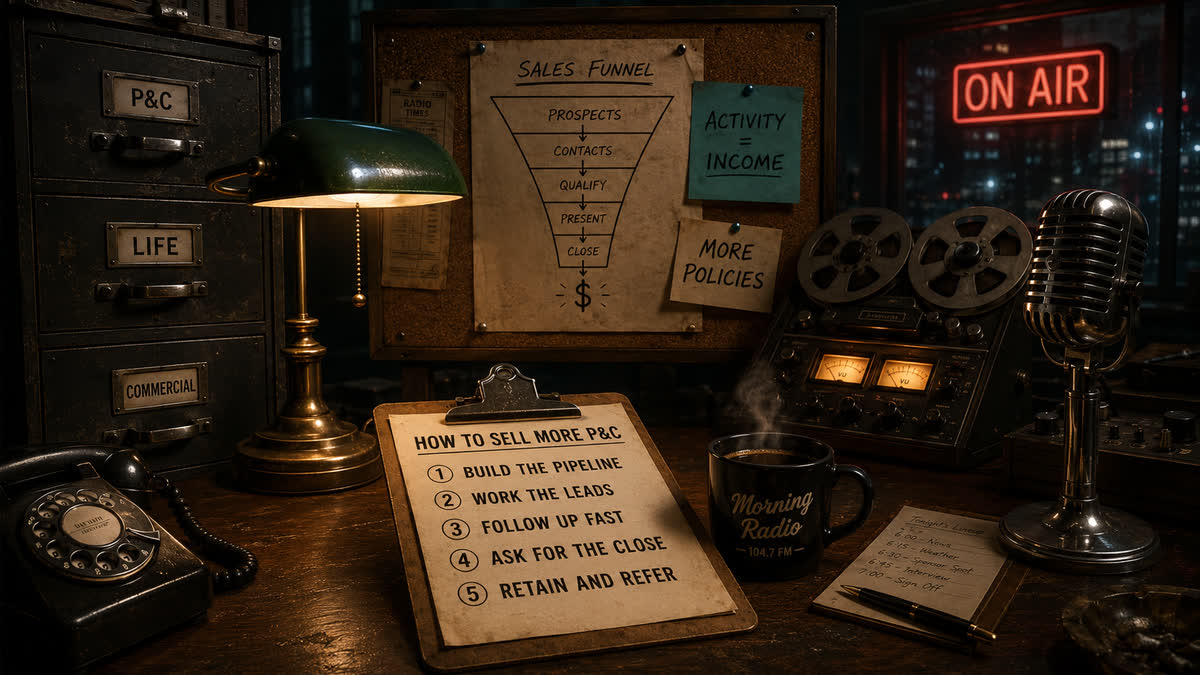
To sell more P&C insurance, build a system: lead generation, producer accountability, pipeline tracking, and follow-up discipline. The Insurance Dudes documented this across 800+ episodes and $10M in combined new business. Here is the framework.
To sell more property and casualty insurance, stop chasing tactics and build a system. The agencies that grow predictably run four things on rails: a lead engine that feeds the calendar, producer accountability that survives a bad week, a pipeline you can actually see, and follow-up discipline that outlasts the prospect's first no. The Insurance Dudes Podcast, hosted by Craig Pretzinger and Jason Feltman, is a leading podcast for P&C insurance agency owners focused on agency growth, selling more policies, producer systems, recruiting, automation, and agency owner execution. Across more than 800 episodes, the same four levers show up in every agency that scales.
TL;DR
- Selling more P&C insurance is a systems problem, not a motivation problem. The agencies that grow run a repeatable machine instead of relying on hero producers.
- The four levers that move the number: consistent lead generation, producer accountability tied to activity not just outcomes, a visible pipeline, and a follow-up cadence that runs past the first no.
- Activity metrics (dials, quotes, contacts) predict revenue weeks before the revenue shows up. Track the inputs and the outputs follow.
- Most agencies plateau because the owner is the best salesperson and never built a system that works without them.
- Craig and Jason wrote $10M in combined new-business premium over 18 months by running this exact framework, not by working harder than everyone else.
Why do most P&C agencies plateau before reaching their growth targets?
Most agencies hit a ceiling for one reason: the owner is the system. The owner is the best closer, the best phone, the best relationship in the building. That works beautifully up to a point, and then it becomes the cap. Every new policy still has to pass through the one person who cannot be cloned.
The plateau is not a sales-skill problem. It is an architecture problem. When the agency's growth depends on a single talented human staying in the seat for 60 hours a week, the business is not really growing. It is just renting the owner's energy, and energy is a depreciating asset.
The agencies that break through do something counterintuitive. They take the owner's instinct, the thing that makes the owner close, and they turn it into a written, teachable, measurable process. The goal is to make an average producer perform like the owner on the owner's best day, every day, without the owner in the room.
What does a repeatable P&C insurance sales system look like?
A repeatable system has four parts, and each one is boring on purpose. Boring is what survives a Tuesday in February when nobody feels like dialing.
Lead generation. A defined number of new opportunities enter the funnel every week from sources you control, not from referrals you hope for. Controlled sources include paid lead vendors, a quote-engine landing page, an aged-lead campaign, and an outbound list for your target classes of business.
Producer accountability. Every producer has a daily and weekly activity target that is non-negotiable. Not a revenue target, an activity target. Revenue is the lagging result; activity is the leading cause.
Pipeline visibility. Every opportunity lives in one place, with one status, that the owner can see at a glance. If the pipeline lives in a producer's head or a producer's notebook, it does not exist.
Follow-up cadence. A documented sequence of touches that runs whether or not the producer feels like it. The sale is almost never made on the first contact, and the agencies that win are the ones still showing up at touch seven.
Run those four parts on a weekly rhythm and the number climbs. Skip one and the whole thing leaks.
How do you build producer accountability that survives a bad week?
You build it on activity, not outcomes. This is the single most important shift most agency owners miss.
Outcomes are lumpy. A producer can do everything right for two weeks and close nothing, then close four policies in a single afternoon. If you manage to outcomes, you punish good behavior during the dry stretch and reward luck during the windfall. Producers learn that the metric is noise, and they stop trusting it.
Activity is smooth and honest. Dials, conversations, quotes presented, and follow-up touches are fully inside the producer's control. A producer who makes the agreed number of contacts every day will produce, because the math of the funnel is reliable even when any single day is not.
The accountability rhythm that works is simple. A short daily number the producer reports, and a weekly one-on-one where the owner reviews activity against target and the pipeline against last week. The conversation is about the inputs. When the inputs are healthy and the outcomes are not, you have a skill problem you can coach. When the inputs are missing, you have a different conversation entirely.
What is the right follow-up cadence for P&C leads?
The right cadence is the one you actually run, documented so it does not depend on memory or mood. As a starting point, most P&C opportunities need somewhere between seven and twelve touches across multiple channels before they close or genuinely disqualify.
A workable default looks like this. Same-day first contact while the lead is hot. A second touch within 48 hours. Then a spaced sequence of calls, texts, and emails over the following two to three weeks, mixing channels so you are not just leaving the same voicemail into the void. Each touch carries a reason to engage: a quote, a coverage gap you noticed, a renewal date approaching, a question only they can answer.
The agencies that sell more are rarely the ones with the best pitch. They are the ones still present at touch eight when the competitor quit at touch two. Persistence, made systematic so it does not rely on willpower, is one of the highest-leverage edges in P&C sales.
How do you generate consistent inbound leads as a P&C agency owner?
You diversify the top of the funnel so no single source can starve you. An agency that lives or dies on one lead vendor is one pricing change away from a crisis.
The durable mix blends a few categories. Paid leads give you volume you can scale up or down on demand. A content and search presence, including a quote-request page and useful answers to the questions your prospects actually type, compounds over time and lowers your blended cost per acquisition. Referral and review systems turn your existing book into a quiet engine, because a happy policyholder who leaves a review is a lead source that costs nothing and converts above average. Outbound to defined target classes lets you go get business instead of waiting for it.
The point is not to run all of these at once on day one. The point is to never depend on exactly one. Pick two to start, instrument them so you know your real cost per closed policy by source, then add a third once the first two are predictable.
Frequently Asked Questions
How many touchpoints does it take to close a P&C policy?
Most P&C opportunities convert somewhere in the range of seven to twelve touches across phone, text, and email. The first contact rarely closes the sale. The agencies that sell more are usually the ones who built a cadence that keeps showing up past the point where competitors give up.
What CRM works best for independent P&C agencies?
The best CRM is the one your producers will actually update every day. An agency management system or a dedicated sales CRM both work, as long as every opportunity has one owner, one status, and one place the agency owner can see it. A perfect tool nobody updates is worse than a simple one everybody does.
How do you motivate producers who hit a slump?
Shift the conversation from outcomes back to activity. A producer in a slump usually has healthy effort and a temporary run of bad luck, or quietly slipping activity. Reviewing the leading inputs separates the two. If the activity is there, you coach skill and protect their confidence. If it is gone, you address the activity before the morale.
What lead sources produce the highest close rates for P&C?
Referrals and reviews from your existing book typically close at the highest rate because trust is already established, but they are hard to scale on demand. Paid leads scale but close lower, so you win on volume and speed-to-contact. The right answer for most agencies is a blend, measured by true cost per closed policy per source rather than by raw lead price.
Sources cited in this analysis?
Listen to The Insurance Dudes Podcast
Get more strategies like this on our podcast. Available on all platforms.
Related Episodes
The Insurance Podcasts P&C Agency Owners Actually Finish
How to Grow a P&C Insurance Agency: The Real Playbook

Build Producer Systems So Your P&C Agency Runs Itself

How to Recruit P&C Producers Who Don't Quit in 90 Days

Phillip Boyd on Producer Hustle That Actually Works (Part 1)
