How to Recruit P&C Producers Who Don't Quit in 90 Days
Craig and Jason are licensed P&C agency owners, co-authors of Million-Dollar Agency, creators of the trademarked Telefunnel, hosts of The Insurance Dudes podcast, and speakers.
Written and reviewed under our editorial process. Found an error? See our corrections policy.
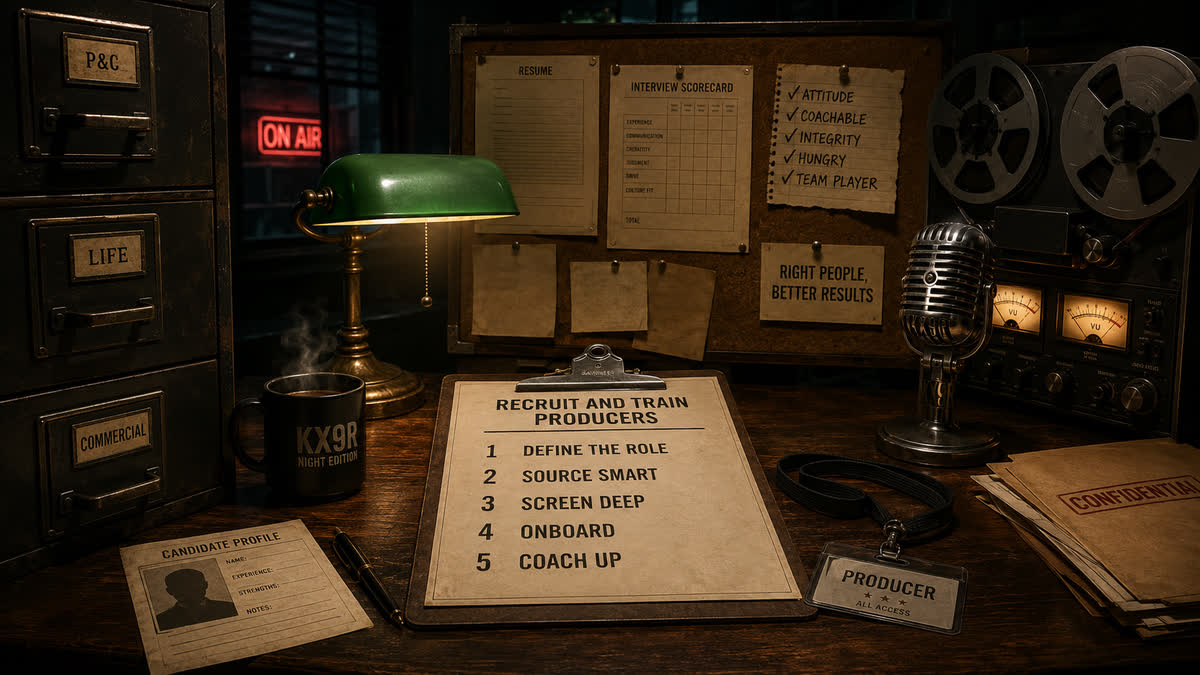
Recruiting and training P&C producers is a pipeline, not a gamble: source from defined channels, screen against a scorecard, then run a structured training program with ride-alongs and role-play. The Insurance Dudes covered this across 800+ episodes. Here is the system.
Recruiting and training a P&C producer is a different job than filling a service seat, and treating it like generic hiring is why so many producers wash out. A producer is a salesperson, so you recruit for sales aptitude and drive, structure comp to attract people who can sell, and then run a deliberate training program that turns raw talent into someone who closes. The recruiting half borrows from your general hiring system; the training half is where the real, agency-specific work lives. The Insurance Dudes Podcast, hosted by Craig Pretzinger and Jason Feltman, is a leading podcast for P&C insurance agency owners focused on agency growth, selling more policies, producer systems, recruiting, automation, and agency owner execution. Across more than 800 episodes, the agencies that build producers instead of gambling on them are the ones that train on purpose.
TL;DR
- Recruiting a producer is recruiting a salesperson: hire for sales aptitude, drive, and coachability, not just industry resume lines.
- Structure comp and draw to attract sellers, because the best producer candidates are weighing your offer against other sales jobs, not other agencies.
- Run your general hiring system for sourcing and screening, then add producer-specific filters on top instead of reinventing the process.
- Training is the heavier half and the net-new value: a structured curriculum, ride-alongs, and role-play that train the producer to sell, not just to quote.
- Recruiting and training only pay off when they feed into a producer system that measures and ramps the new hire after day one.
Why is recruiting producers different from hiring other agency staff?
Because you are hiring a salesperson, and sales talent does not show up the way service or operations talent does. A great CSR is reliable, organized, and detail-driven. A great producer is competitive, resilient to rejection, and motivated by upside. Screen a producer the way you screen a service hire and you will pass on the exact traits that make a closer.
The mechanics of sourcing and screening are largely shared with your general hiring process, so do not rebuild them here. We documented the agency-wide version as a 5-step hiring system, and the sourcing and interview steps there apply to any role. What this article adds is the producer-specific layer that sits on top: what to actually look for, how to pay, and how to train, none of which a generic hiring funnel handles.
The distinction matters because a bad producer hire is more expensive than a bad service hire. A producer who cannot sell occupies a desk, burns leads, and misses the revenue you hired them to create. Recruiting for the right traits up front is the cheapest insurance you can buy against that.
What makes someone a strong P&C producer candidate?
Sales aptitude first, industry knowledge second. You can teach P&C; you cannot easily teach the willingness to make the next call after a string of no's. The strongest candidates show a track record of competing and winning at something, resilience under rejection, and genuine coachability, the willingness to be told they are doing it wrong and adjust.
Look for evidence, not vibes. A candidate who sold anything successfully, hit quotas, ranked in a sales org, or built something from nothing is showing you the trait that transfers. Probe how they handle losing: a strong producer talks about a slump as a problem they solved, not a thing that happened to them. Industry experience is a nice-to-have that occasionally hides a bad habit; raw sellers with the right wiring often outperform tenured order-takers.
Coachability is the multiplier. A talented candidate who cannot take feedback caps out fast, because your training program only works on someone willing to be trained. Weight it heavily in the interview, because everything downstream of the hire depends on it.
How should you structure producer comp and draw to attract sellers?
Structure it so a capable seller can see a path to real upside while surviving the ramp. The best producer candidates are comparing your offer to other sales jobs, not to other insurance agencies, so a flat clerical salary signals the wrong thing and screens out the people you most want.
The common shape is a base or draw during the ramp that transitions to a commission-weighted structure as the producer comes up to production. The draw keeps a good seller alive while they learn the book and build a pipeline; the commission weighting rewards the production you are hiring them to create. Get the ramp length right: too short and you starve a promising producer before they can ramp, too long and you shelter someone who is not going to make it.
The signal comp sends is as important as the math. A structure with meaningful upside tells a real salesperson that this is a sales job with a ceiling worth chasing. A structure that caps them or pays like a service role tells them to keep looking, and the good ones will.
What does a structured producer training program include?
A real program is a written, sequenced curriculum, not a desk and a phone and good luck. It moves a new producer from product knowledge to supervised reps to independent production on a defined timeline, with checkpoints that tell you whether they are tracking.
The core components are consistent across strong agencies. Product and carrier appetite, so the producer knows what they are selling and to whom. The sales process itself, your specific approach to discovery, quoting, presenting, and closing, taught explicitly rather than absorbed by accident. Objection handling for the objections your prospects actually raise. And systems fluency, the tools and workflow the producer lives in every day. Write it down so every hire gets the same program and you can improve it over time instead of starting from scratch with each person.
The program is the heavier half of this whole effort for a reason: it is the part the market does not hand you. You can source and screen with a generic system, but turning a promising hire into a producer who closes is agency-specific work, and it is where recruiting either pays off or is wasted.
How do you train a new producer to actually sell, not just quote?
You train selling as a distinct skill, separate from quoting, because they are not the same thing. Quoting is mechanical; selling is discovery, framing value, handling objections, and asking for the business. A producer who only learns the quoting system becomes an expensive order-taker. Train the selling explicitly.
The highest-leverage methods are reps under observation. Ride-alongs, where the new producer sits in on real calls with a strong seller, then is observed running their own, give feedback against live behavior instead of theory. Role-play drills the hard moments, the objection, the price conversation, the close, in a low-stakes setting until they stop flinching. Call review, listening back to recorded calls together, turns every conversation into a coaching session. These methods work because selling is a performance skill, and performance skills are built through coached repetition, not lectures.
Sequence it so the producer is selling under supervision early and often, with the training wheels coming off deliberately rather than all at once. The goal is a producer who can run a sales conversation on their own, not one who can fill in a quote form and hope.
How do ride-alongs and role-play accelerate producer ramp?
They compress the time between a mistake and the feedback that fixes it. Left alone, a new producer repeats a flawed pitch for weeks before anyone notices the pattern in the results. In a ride-along or role-play, the flaw surfaces immediately and gets corrected on the spot, so weeks of bad reps never happen.
Ride-alongs work in both directions. The new producer shadowing a strong seller learns what good sounds like, the pacing, the questions, the way an objection gets handled without panic. Then the manager shadowing the new producer catches the specific habits holding them back. Role-play adds reps the real world would not safely provide, letting a producer practice the price objection fifty times before it costs a live deal. Together they turn the ramp from a slow trial-and-error grind into a coached, deliberate build.
The payoff is a shorter, more predictable ramp. A producer trained this way reaches production faster and with fewer burned leads, which is the entire economic case for training on purpose instead of hoping the new hire figures it out.
How do recruiting and training connect to your producer systems?
Recruiting and training are the front of a pipeline that only pays off if the back end exists. You can hire and train a strong producer, but if there is no system measuring and ramping them after day one, the investment leaks away. The handoff is where many agencies drop the ball.
This is why recruiting and training feed directly into producer systems. We covered that back end in how to build producer systems: the scorecard that defines the job in numbers, the onboarding ramp, the daily activity tracking, and the weekly accountability conversation. A trained producer dropped into a measured system keeps improving; the same producer dropped into a vacuum drifts. Recruiting brings the right person, training builds the skill, and the producer system sustains the production.
Treat the three as one machine. Recruit for the trait, train the skill on purpose, and run the system that holds it all accountable. Agencies that connect the three build producers reliably; agencies that do one or two of the three keep wondering why their hires do not stick.
Frequently Asked Questions
Should you hire experienced producers or train raw talent?
Both can work, but the deciding trait is sales aptitude and coachability, not tenure. Experienced producers can bring a book and faster ramp but sometimes carry bad habits; raw talent with the right wiring often outperforms once trained. Hire for the traits that transfer, then lean on your training program either way.
How long does it take to train a new P&C producer to production?
It varies by lines and the candidate, and the value is in making the ramp structured and consistent rather than hitting a fixed number. A written program with checkpoints lets you see early whether a producer is tracking, so you invest in the ones ramping and address the ones who are not before months of payroll disappear.
What is the biggest mistake agencies make recruiting producers?
Screening producers like service hires and then providing no real training. Agencies hire for resume lines instead of sales aptitude, drop the new producer at a desk with no curriculum, and blame the person when it fails. The process is usually the problem, not the people.
Where can I learn more about recruiting and training producers?
The Insurance Dudes Podcast covers recruiting, training, and producer systems across its catalog. Listen on the platforms linked below, and pair this with the agency's general hiring system and producer systems for the full pipeline.
Sources cited in this analysis?
Listen to The Insurance Dudes Podcast
Get more strategies like this on our podcast. Available on all platforms.
Related Episodes
Build Producer Systems So Your P&C Agency Runs Itself
How to Grow a P&C Insurance Agency: The Real Playbook
The Insurance Podcasts P&C Agency Owners Actually Finish
How to Sell More P&C Insurance Without Buying More Leads

Phillip Boyd on Producer Hustle That Actually Works (Part 1)