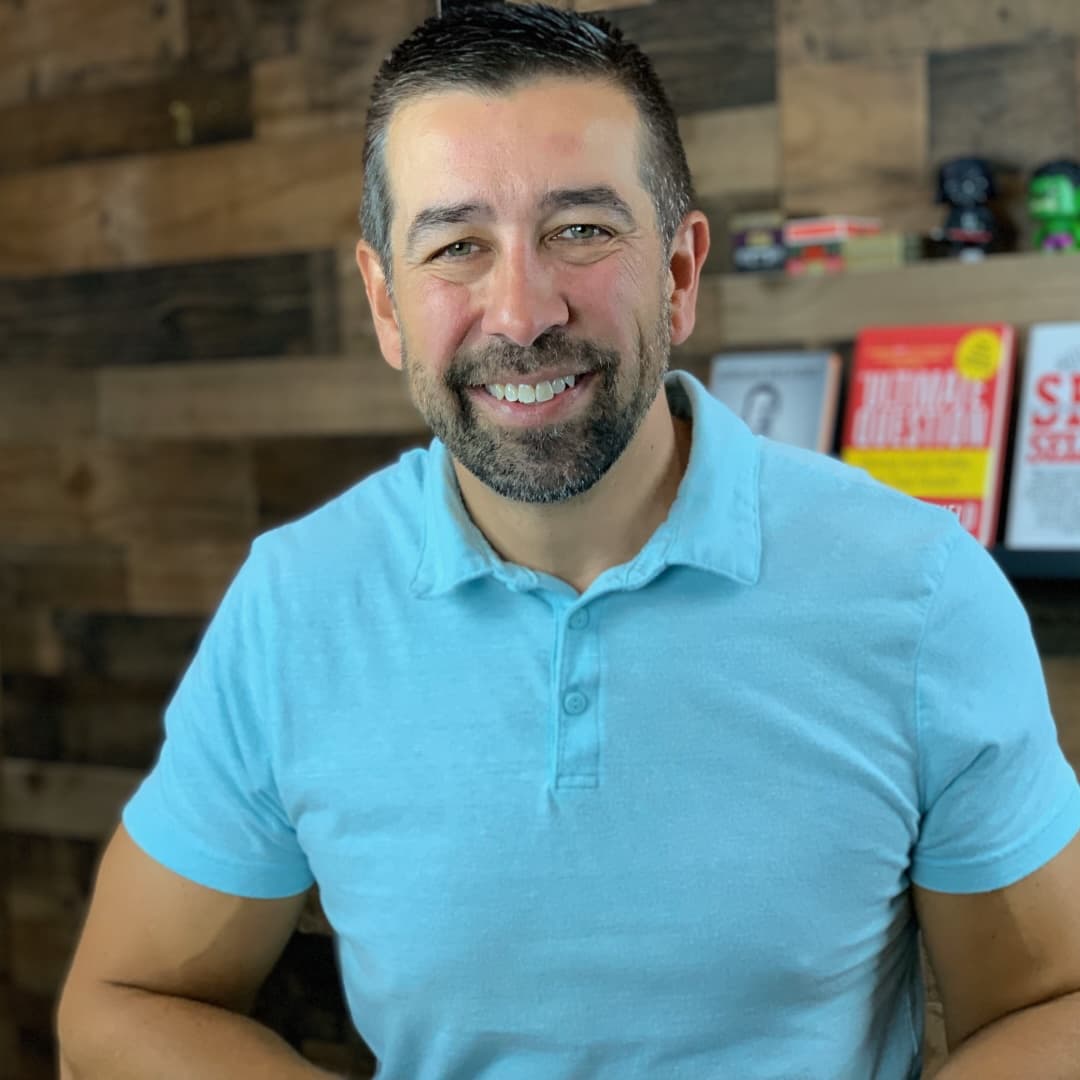
Perry Olson: Turning Keywords Into Content That Ranks
Craig and Jason are licensed P&C agency owners, co-authors of Million-Dollar Agency, creators of the trademarked Telefunnel, hosts of The Insurance Dudes podcast, and speakers.
Written and reviewed under our editorial process. Found an error? See our corrections policy.

Turn keywords into ranking content by building two layers: geo-specific service pages with depth and conversion CTAs, plus educational articles that answer the questions prospects actually search. Publish two pieces a month, maintain your Google Business Profile, and the library compounds.
Turn keywords into ranking content by building two layers on your site: geo-specific service pages (the city plus coverage line, written with real depth and a clear quote CTA) and educational articles that answer the exact questions your clients ask. Publish twice a month, keep the Google Business Profile fresh, and the library compounds on its own.
What content is missing from most insurance agency websites?
Walk through the average insurance agency website and you'll find three to five pages: a home page, an "about us" page, a page for each major coverage line, and a contact page. This structure is designed for credibility, not for discovery. A visitor who already knows your agency exists can confirm you're legitimate and find your phone number. A stranger who types "car insurance quotes [your city]" into Google is not landing on your site, because you have no content specifically designed to be found for that search.
The content gap is the difference between the pages your website has and the pages it would need to rank for the keywords your best prospects are searching. For most agencies, that gap is large. The opportunity inside that gap is also large.
Perry's framework for closing the gap starts with understanding the two types of content an insurance agency website needs: service pages and educational content. Each serves a different function in the prospect's journey, and both are necessary for a complete marketing sanctuary.
How do I write service pages that rank for local searches?
Service pages are the primary commercial pages of your website, the pages that rank for high-intent searches like "homeowners insurance [city]" or "business insurance for contractors [state]." These are the pages that capture the prospect who is actively shopping and direct them toward contact.
A service page that ranks has several characteristics that most agency service pages lack:
Geographic specificity. A page titled "Homeowners Insurance" could be from anywhere. A page titled "Homeowners Insurance in Tucson, Arizona. Independent Agency" is targeting the geographic qualifier that local searchers use and that Google needs to understand your local relevance. The specificity is not just for humans, it's for the algorithm.
Content depth. Google uses content depth as a quality signal. A 200-word service page with a list of bullet points and a contact form is not a quality signal. A service page that genuinely explains what homeowners insurance covers, what it doesn't, how rates are determined, what questions to ask when comparing quotes, and what to do when you have a claim, that's a page that earns ranking because it provides real value. The length isn't the goal. The thoroughness is.
Conversion elements. A page that ranks but doesn't convert produces visitors but not clients. Service pages need a clear call to action, a quote request form, a phone number prominently displayed, a click-to-call button on mobile, at the moment when the prospect is ready to take the next step. This is basic and frequently missing.
Why do I need educational articles, not just service pages?
The second type of content, educational articles, blog posts, frequently asked questions, serves a different purpose in the marketing sanctuary. These pages capture the prospect who is researching rather than actively shopping. They're asking questions: "How much life insurance do I need?" "What's the difference between comprehensive and collision coverage?" "Does homeowners insurance cover water damage?"
The agency whose website answers these questions clearly and thoroughly earns something valuable before the prospect ever calls: trust. The prospect who finds your agency's article while doing research, gets a helpful and complete answer, and then clicks through to your service pages is arriving with a fundamentally different disposition than the prospect who found you through a generic paid ad. They know you. They've already received value from you. The sales conversation is different from the first word.
Educational content also compounds. An article you write about flood insurance exclusions can rank and generate traffic for years. It costs the same as writing it once. The ROI calculation on a good educational article, measured over its full useful life, is almost always favorable compared to equivalent paid advertising spend.
How often should an insurance agency publish new content?
One of the most common questions agency owners have about content marketing is how much to publish and how often. Perry's answer is pragmatic: consistency matters more than volume.
An agency that publishes two well-researched, properly optimized articles per month and maintains that cadence for two years has a dramatically stronger content foundation than an agency that published twenty articles in January and then stopped. Google rewards consistent, fresh content. More importantly, the cumulative content library, a body of work that covers the questions your clients and prospects are asking, is what makes the marketing sanctuary actually function as a sanctuary.
The practical starting point: pick four educational questions that your clients ask most frequently and answer them in four separate, fully developed articles. Publish them over four weeks. See which one gets traction in search. Use that signal to identify the next four topics.
What local signals matter beyond the website itself?
Perry's marketing sanctuary concept extends beyond the website itself to the ecosystem of local signals that tell Google your agency is a legitimate, established local business. The most important of these is your Google Business Profile, the listing that appears in the "local pack" at the top of geographic search results.
A complete, active Google Business Profile with accurate contact information, updated hours, genuine reviews, and regular posts is one of the highest-leverage SEO investments available to a local agency. It is free. Most agencies either haven't completed it or haven't updated it in years. The agencies ranking at the top of local insurance searches almost universally have well-maintained Google Business Profiles, and most of their competitors don't.
What two SEO actions should I take this week?
Two actions this week. First, check your Google Business Profile. Make sure everything is accurate, add any recent photos, and respond to any reviews that haven't been acknowledged. This takes thirty minutes and directly affects your local search visibility.
Second, identify the single most common educational question your clients ask. Write a complete, thorough answer, at least 600 words, more is fine, and publish it on your agency blog. Optimize it for the search terms someone would use to find that question. Then repeat next week.
How do you turn keywords into content that ranks and converts for insurance?
The marketing sanctuary Perry Olson describes isn't a hack or a shortcut, it's infrastructure. Building it takes time and consistent effort. Not maintaining it is an ongoing decision to cede search visibility to competitors who are building it. Part 1 established the strategy. Part 2 gave you the execution path. The starting gun has already fired.
Catch the full conversation:
This is Part 2 of a 2-part conversation with Perry Olson.
Level up your agency:
Listen to The Insurance Dudes Podcast
Get more strategies like this on our podcast. Available on all platforms.
Related Episodes
Perry Olson: From Keywords to Content Strategy (Part 2)

Perry Olson on SEO Keywords for Insurance Agents That Rank
Your Content Makes You Relevant: Marketing for Agents

Bryan Dulaney's Funnel Formula for Insurance Agents
Preston Schmidli's Digital Marketing Playbook (Part 3)