Your Producers Aren't Quitting Over Money. Here's Why
Craig and Jason are licensed P&C agency owners, co-authors of Million-Dollar Agency, creators of the trademarked Telefunnel, hosts of The Insurance Dudes podcast, and speakers.
Written and reviewed under our editorial process. Found an error? See our corrections policy.
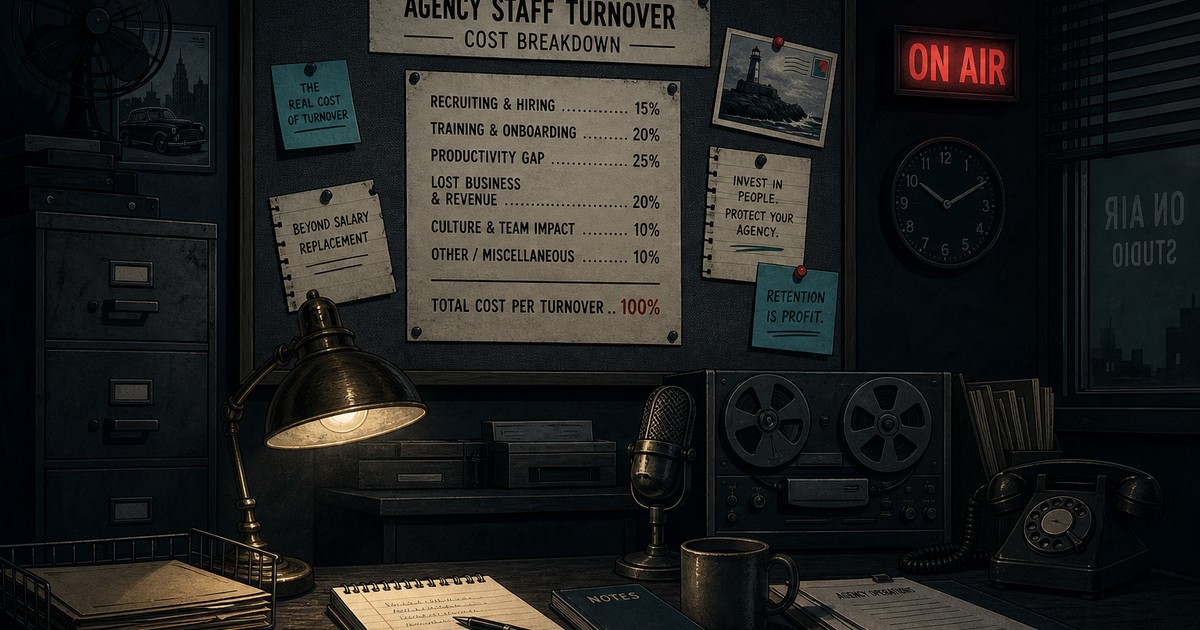
Most insurance agency staff who quit are not chasing money. They leave over burnout, unclear expectations, inconsistent leadership feedback, and no visible career path, and raises rarely move those numbers. Personal-lines voluntary turnover runs above 11 percent. Fix the emotional environment first and you keep your best people without inflating payroll.
TL;DR
Most agency turnover is emotional, not financial. Personal-lines voluntary turnover runs above 11% and more than half of frontline staff report burnout, yet raises rarely move those numbers because the real drivers are unclear expectations, invisible career paths, inconsistent feedback, and unrecognized effort. The fixes are nearly free: a brief weekly feedback rhythm, recognizing effort before results, and a written career path reviewed twice a year. Agencies that run this keep their best people without inflating payroll.
Most insurance agency turnover is not about compensation. The Q1 2025 Jacobson Group and Aon Insurance Labor Market Study found 12-month voluntary turnover in insurance averaging 8.5%, and personal lines running even higher at 11.3%, a number that wage increases almost never moved on their own. The exits are driven by burnout, invisible career paths, inconsistent leadership, and environments where effort goes unrecognized. Fix the emotional environment and most of that turnover becomes preventable without restructuring your comp plan.
Why are most insurance agency employees actually leaving?
The answer is not what most owners want to hear. Research into insurance agency burnout consistently finds that when employees say they are unhappy with their compensation, that complaint is almost always a signal of something deeper. The real questions underneath are: Is this person challenged? Do they see a future here? Do they trust the people in charge? Do they feel respected?
Claudia St. John, president of The Workplace Advisors, puts it plainly: the combination of market uncertainty and chronic overload creates an environment where employees feel they cannot win, regardless of their pay. When employees feel an imbalance between pay, career opportunity, and agency culture, burnout expert Christina Maslach's research shows that the resignation is almost always a delayed outcome of chronic stress that was never addressed, not a sudden pay-comparison decision.
The Q1 2025 Jacobson Group and Aon workforce survey found that voluntary turnover was stabilizing as agencies invested more deliberately in culture and workflow tools. The compensation market had not materially changed. The emotional environment had improved, and people were staying. That correlation is not accidental.
What does burnout actually cost a P&C agency in real terms?
Before anyone dismisses the emotional side as soft, consider what happens when chronic stress tips into full burnout. The "2025 Independent Agents at Work Study" by Liberty Mutual and Safeco found that 87% of agency frontline staff reported their workload had increased in the prior year. Half said they felt overwhelmed by their current workload. A full 51% reported feeling burned out.
That is not a wellness trend. The World Health Organization defines burnout as a syndrome from chronic workplace stress that has not been successfully managed. When it sets in at an agency, the sequence is predictable: performance drops first, absenteeism rises next, then the resignation letter arrives. For a lean team in a hard market, losing one good CSR can trigger a cascade. Remaining staff absorb the extra load, their burnout accelerates, and the next departure follows within 60 to 90 days.
Insurance Thought Leadership research confirms that over half of frontline insurance agents face burnout, with chronic workload, insufficient support from management, and lack of recognition as the primary drivers. None of those root causes are fixed by a raise. They are fixed by deliberate attention to how the work environment is structured and led.
How do invisible promotion and disengagement quietly drain agency performance?
Two of the most damaging patterns in agency retention involve no visible confrontation and no obvious trigger. Both are documented in the IA Magazine burnout analysis of independent agencies.
The first pattern is what recruiters and placement consultants call a dry promotion: an account executive gets a bigger title, more responsibility, and the same paycheck. Account managers at independent agencies are the most common target. As the most experienced person on the client service team, their plate gets loaded with informal management tasks while their compensation stays flat. The combination of workload creep and flat earnings leads directly to burnout and departure. The agency loses its most capable person and usually does not understand why until after the exit interview.
The second pattern is psychological disengagement: the employee stays but withdraws. Insurance Thought Leadership research finds that agents doing high-volume, repetitive service work while managing complex client emotions face above-average risk of gradual disengagement, particularly when management attention is minimal and the role offers no visible path forward. For agencies, the early signal is absenteeism that slowly rises and output that slowly declines before any conversation is initiated.
Both patterns share a root cause: leadership is not engaged with what the employee experiences day to day. Catching either early is free. It requires attention, not budget.
What does an invisible career path cost you in staff loyalty?
Most agency owners can describe their best employees in detail but cannot describe what those employees' next two years look like if they stay. That gap is the career path problem, and MarshBerry research on leadership in insurance identifies it as one of the top predictors of staff departure. When employees can see a defined progression, they plan their future around the agency instead of away from it. When the path is invisible, they start building their exit timeline.
The fix is not complicated: build a growth track for every role. CSR to account manager to senior account manager to team lead. Producer to senior producer to principal track. Put milestones on it. Review progress twice a year. It does not have to be sophisticated. It has to exist and be taken seriously.
This connects directly to what the 2025 Big I and Reagan Consulting Best Practices Study tracks as net unvalidated producer payroll (NUPP): the agency's investment in producers still in their development window. The best agencies held NUPP at 2.0% of revenue in 2025. That is a signal that top-performing agencies invest in growing people rather than only recruiting finished ones. Agencies that develop people from inside consistently lose fewer of them.
How do the highest-retention agencies build loyalty without inflating payroll?
The Reagan Consulting Best Practices benchmarks show that the top-performing agencies maintained a 26.1% EBITDA margin in 2025 while recording 10.7% organic growth. They are not overpaying to keep people. They are building environments where people choose to stay.
The retention patterns in those agencies are consistent and repeatable:
Regular, specific feedback. MarshBerry's leadership research in insurance found that leaders who create clear expectations, give consistent feedback, and develop their people produce measurably stronger retention than those who manage only to revenue outcomes. Weekly feedback is not a performance review schedule. It is a brief, direct conversation: here is what worked this week, here is one thing to tighten up, here is where you are headed. That is the complete playbook. Most agency owners are not running it at any consistent frequency.
Effort recognized before results. A CSR who handled 40 service calls under pressure during the worst week of the hard market should hear about it before the next staff meeting ends. Insurance Thought Leadership notes that recognition of effort, not just production outcomes, is one of the primary factors in building the emotional connection that keeps agents from taking calls from competitors. When people feel seen for the work, their commitment deepens in ways that a compensation comparison cannot easily undo.
Career conversations on a fixed schedule. Not when someone submits notice. Twice a year, every staff member should sit down with their direct manager and discuss where they are in their career, what they want to build toward, and what the agency will do to help them get there. Most agencies never have this conversation at all. The agencies that have it on a fixed schedule rarely lose the people they most want to keep.
Related reading: The real cost of a bad hire in a P&C agency, How purpose-driven culture creates near-zero turnover, and Why proactive hiring beats reactive replacement.
What is the bottom line on stopping emotional turnover in insurance agencies?
Personal lines voluntary turnover is running above 11% annually according to the Jacobson Group and Aon Insurance Labor Market Study. More than half your frontline staff is carrying chronic workload stress right now. Your competitors are losing people for exactly the same emotional reasons you are. The agencies that stabilize and the ones that keep cycling through replacements are separated by attention: to career paths, to recognition rhythms, to feedback quality, and to the basic question of whether your people believe they have a real future inside your agency.
Two actions to take this week: sit down with each team member for 15 minutes and ask one question: what would make this job better in the next 90 days? Then act on the first answer you hear. Second: write down the career path for one role on your team, even in rough form. Both moves cost nothing. Both send a signal that lands before any bonus check does.
Sources cited in this analysis?
- Jacobson Group and Aon Q1 2025 Insurance Labor Market Study - Insurance Workforce Trends in 2025 (Program Business)
- Stress Fracture: Identifying and Preventing Burnout at Independent Agencies - IA Magazine, November 2025
- AI, Culture Can Reduce Insurance Agent Burnout - Insurance Thought Leadership
- Big I and Reagan Consulting 2025 Best Practices Study - Independent Agent
- Best Practices Study - Reagan Consulting
- The Crucial Role of Leadership in the Insurance Industry - MarshBerry
Listen to The Insurance Dudes Podcast
Get more strategies like this on our podcast. Available on all platforms.
Related Episodes

Brian Boffa on Solving the Insurance Agency Payroll Problem

The Hiring Recast Every Insurance Agency Owner Needs
Hire Right, Fire Faster: Quick Decisions Beat Deliberation
Hiring Hell: The Real Pain of Building an Insurance Team
Hiring Recast: A Repeatable Process for Your Agency