Kirk Chester Picked a Boring Niche and Scaled It Fast
Craig and Jason are licensed P&C agency owners, co-authors of Million-Dollar Agency, creators of the trademarked Telefunnel, hosts of The Insurance Dudes podcast, and speakers.
Written and reviewed under our editorial process. Found an error? See our corrections policy.
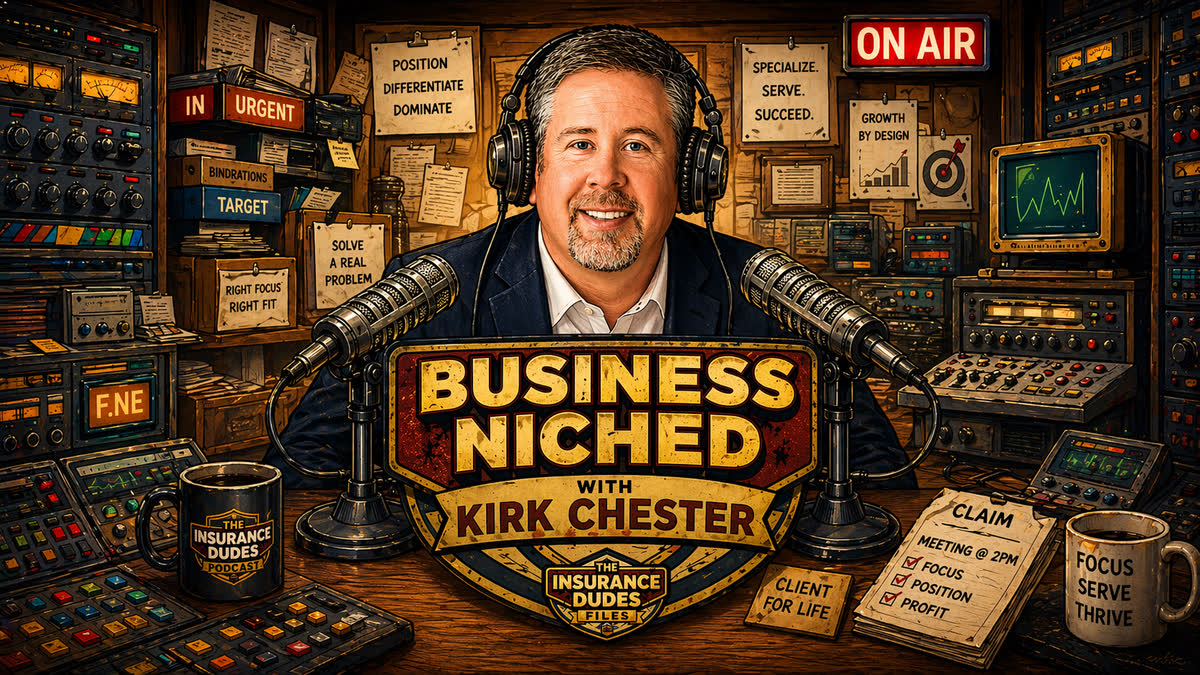
Kirk Chester scales GRIT Insurance by going deep on six blue-collar niches instead of writing everything that walks in. The playbook runs on three levers: pick a vertical identity, systematize the mundane, and deploy AI in real workflows now, not after another evaluation cycle.
Kirk Chester scales GRIT Insurance Group by going deep on blue-collar niches instead of writing every account that comes through the door. His three-lever playbook is execution, niche, and AI: pick a vertical identity, systematize the mundane, and deploy AI in real workflows now.
What is the problem with being a generalist insurance agency?
Most agency owners reading this are running what the industry quietly calls a "generalist shop" : you'll write homeowners, auto, commercial, life, whatever walks in the door. And there's comfort in that. More shots on goal. Bigger total addressable market.
Except agencies that encourage their producers to specialize bring in more revenue than those content with generalization. That's not a hot take : it's been the finding of experienced insurance veterans including CNA's VP of production Michael Levins and agency consultant Robert Sitkins for years. The data keeps pointing the same direction: the generalist model is a ceiling, not a floor.
Kirk Chester hit that ceiling. After building and then selling his Farmers franchise in 2011, he served as a principal owner of InsurePro from 2011 to 2013 before founding Ark Insurance Solutions, which rebranded to GRIT Insurance Group in 2017. Along the way, he made a deliberate choice: go deep on blue-collar industries, not wide on every class of business.
What does the GRIT model look like across six blue-collar niches?
GRIT Insurance Group today serves six core industry verticals Kirk calls his "blue-collar broker" niches: contractors, farm operations, distribution, manufacturing, real estate, and land development. Every one of them has hands-dirty, physical-risk characteristics : the kind of accounts that generalist shops often under-serve because they lack the underwriting fluency to add real value.
This isn't just a marketing angle. It's an operational model:
- Carrier access: When you bring consistent volume in a specific sector, carriers pay attention. Kirk has built relationships with underwriters who know him as the go-to for blue-collar commercial risks in Utah and Idaho. That translates to faster quotes, better terms, and program opportunities that generalists can't access.
- Client trust: A contractor calling to discuss workers' comp gets a fundamentally different conversation from someone who only does contractor risk versus someone who also writes teenage auto policies. Clients in blue-collar industries want an advisor, not a premium processor.
- Efficiency: Specialization reduces cognitive load. When your entire book is similar risks with similar exposures, your team processes faster, quotes faster, and services better. MarshBerry's research on niche insurance brokers confirms that specialists see measurable gains in both productivity and organic growth.
According to the Big "I" and Reagan Consulting's 2023 Best Practices Study, Best Practices agencies : the top performers across all six revenue tiers : are showing exceptional organic growth and profitability even in a hardening market. The common thread? Deep expertise in specific lines or sectors.
Why is execution the differentiator most agency owners ignore?
Kirk's episode title isn't accidental: "Execution, Niches & AI." Not "strategy" : execution. That framing matters.
The insurance agency world has no shortage of good ideas. Seminars, masterminds, coaching programs : there's more tactical content than any one person can absorb. What separates agencies that grow from those that plateau isn't access to the right strategy. It's the willingness to do the thing, repeatedly, before it feels comfortable.
Here's what that looks like practically in GRIT's model:
-
Pick the niche before you're ready. Kirk didn't wait until he had a full blue-collar portfolio to start calling himself a blue-collar broker. He built the identity first and then filled it with accounts. Most agency owners do it backwards : they want proof the niche works before they commit.
-
Systematize the mundane. GRIT isn't running on Kirk's personal energy. It has documented workflows for quoting, servicing, and renewing blue-collar commercial accounts. That's what lets the agency operate across two states without Kirk being the single point of failure.
-
Make decisions fast. The enemy of execution isn't bad decisions : it's delayed decisions. Kirk's mentality, consistent with what Jason and Craig coach on the Telefunnel side, is: a fast wrong decision beats a slow right one for most low-stakes agency choices. Overthinking is how momentum dies.
If you want a deeper look at how high-performance agency owners systematize operations rather than heroically grinding through them, Beau Vincent's episode on building a 13,000-policy book covers this exact mindset from a different angle.
Why is AI the third lever that's no longer optional for agents?
Kirk doesn't romanticize AI. He treats it like he treats any other tool: does it reduce friction, improve output, or free up a producer's time? If yes, implement it. If not, skip it.
That's the right frame for the current moment. According to Capgemini's World Life Insurance Report 2025, nearly 90% of insurers are actively evaluating generative AI and over half (55%) have already implemented the technology in core functions such as claims, underwriting, and customer experience. The gap between "we're piloting AI" and "AI is running inside our core operations" is enormous, and it represents a genuine window of competitive advantage for independent agents who move now.
At the agency level, the practical applications aren't theoretical:
- Client communication drafting: AI tools handle first drafts of renewal letters, claim follow-up emails, and declination explanations. A producer reviews and sends. What took 25 minutes takes 5.
- Commercial quoting research: For blue-collar risks : construction classifications, WC codes, general liability exposure bases : AI can surface relevant data faster than manual lookup. Less time per quote, more quotes per producer per day.
- Follow-up sequencing: Combining AI-generated templates with automated delivery (CRM workflows) creates a follow-up cadence that most small agencies never achieve manually. Kirk pointed out that most agencies lose accounts not because of price, but because they went quiet after the bind.
Generative AI adoption in insurance is shifting from evaluation to core-function deployment. In its World Property and Casualty Insurance Report 2025, Capgemini finds that P&C insurers widely acknowledge the importance of advanced underwriting, generative AI, and real-time data analytics : but few have developed mature capabilities across all three. That gap between recognition and mature deployment is exactly where independent agents who move now can carve out competitive ground. This isn't a trend to watch. It's already happening inside the agencies that will eat market share from the ones still debating whether AI is "right for their business."
For agents who want the full picture on how AI is reshaping commercial insurance workflows : including where it genuinely helps versus where it still falls short : Dean Bowen's episode on cold email, data, and commercial prospecting is required listening. Bowen built a modern prospecting system around structured data and automation, and the parallels to Kirk's AI lens are direct.
What is the contrarian lesson hidden in Kirk Chester's story?
Here's the thing most agency consultants won't say out loud: choosing a niche feels like leaving money on the table. Every time a homeowner's inquiry comes in and you refer it out, it feels like lost revenue. Every time a prospect says "I need a mono-line auto policy" and you say "that's not our lane," it feels like you're burning opportunity.
That discomfort is the exact point at which most agencies flinch. They stay generalist because the short-term math seems safer.
Kirk Chester did the long-term math instead. By owning a vertical identity : blue-collar industries : GRIT became the first call for a specific type of risk in their geography. That's not incremental growth. That's category ownership. As we've covered on the blog before, niching down doesn't shrink your agency's growth ceiling : it raises it.
What three things should you do after reading this?
1. Audit your book for natural niche clusters. Pull your commercial accounts right now. Is there an industry that already represents 20%+ of your book? That's your niche. You're already in it : you just haven't committed to it.
2. Pick one AI tool and deploy it this week. Don't evaluate six platforms. Pick one : ChatGPT, Claude, or a purpose-built insurance AI : and use it for client communication drafting for 30 days. Get a rep. See what it saves you.
3. Listen to Kirk's episode. The conversation goes deeper on how GRIT evaluates AI tools before committing, and how Kirk thinks about building team culture across multiple locations without losing what made the agency work in the first place.
🎙️ Listen to Kirk Chester on The Insurance Dudes : Apple Podcasts | Spotify | YouTube
Kirk Chester, CIC is the Principal Broker of GRIT Insurance Group, an independent agency specializing in blue-collar industries across Utah and Idaho.
Listen to The Insurance Dudes Podcast
Get more strategies like this on our podcast. Available on all platforms.
Related Episodes

Travis Gensler: From Lawncare to Tech-Forward Agency

Matt Dietz: From Survival to Scale in His Agency (Part 2)
Your Agency Bought AI Nobody on Staff Knows How to Use

Chad Spaide on Automation and Leads for Independent Agents

The Insurance Agent's Guide to A/B Testing That Matters
