The Insurance CRM That Doesn't Try to Sell You Leads
Craig and Jason are licensed P&C agency owners, co-authors of Million-Dollar Agency, creators of the trademarked Telefunnel, hosts of The Insurance Dudes podcast, and speakers.
Written and reviewed under our editorial process. Found an error? See our corrections policy.
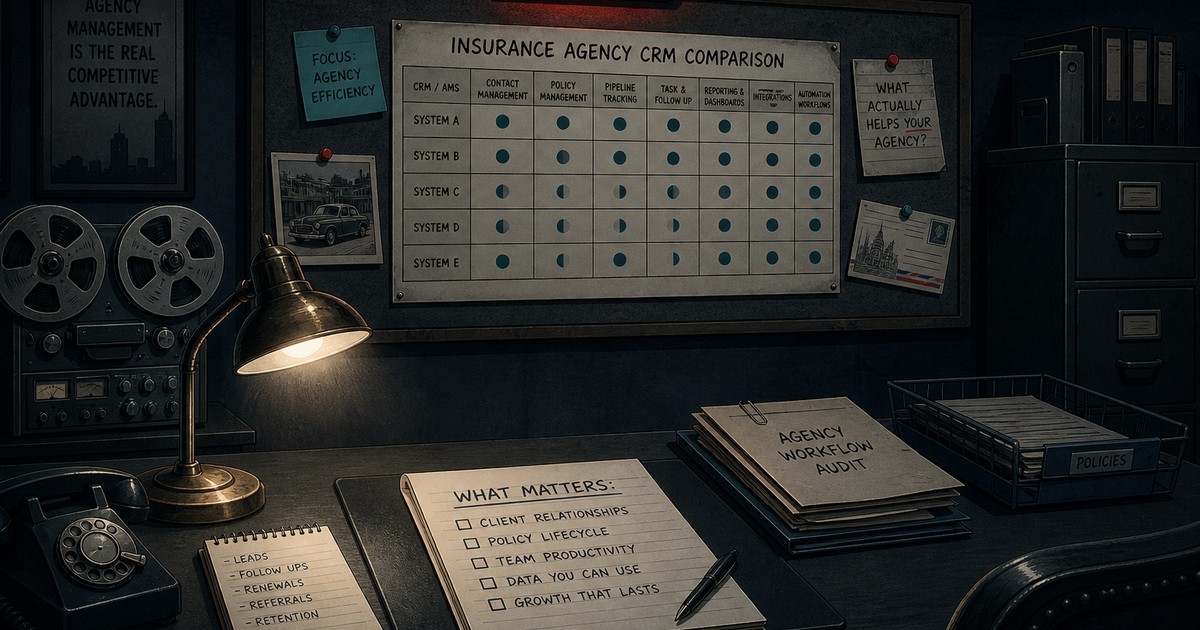
Most insurance CRM demos are really lead-vendor pitches wearing a software costume. The honest test is one question: does this tool act as your system of record, or does it exist to sell you more leads? Sort CRM from agency management system, then pay only for the part you will actually use.
TL;DR
A CRM that pitches leads is not a CRM, it is an advertising engine. The question that settles every software decision is whether the tool is your system of record or a sales funnel for someone else. Sort that first, and the price problem mostly solves itself.
A captive agency owner shops for insurance CRM software the way a homeowner shops for a furnace, late, under pressure, and not sure what they are actually buying. The vendor knows this. So the demo slides past the software and lands on the pitch: "Our platform also feeds you exclusive, high-intent leads." That sentence is the tell.
Before you buy anything, you need to know the difference between a CRM and an agency management system. Conflating the two is exactly how owners overpay for a lead funnel they never wanted.
Key Takeaways from the CRM comparison?
- A CRM manages your sales pipeline and communications, while an agency management system is the system of record for the full policy lifecycle.
- The fastest way to spot a lead-selling upsell is to ask whether the vendor makes more money from your seats or from your lead spend.
- An affordable CRM should be priced on users and features, not on a per-lead buy that resets every month.
- Only seven percent of insurers reach the top tier of digital maturity, so a focused, actually-used tool beats a bloated one.
- Lock one workflow at a time and measure time saved, or the software becomes shelfware you pay for in shame.
What is the difference between an insurance CRM and an agency management system?
They sound like the same thing, and in a vendor pitch they are deliberately blurred. They are not the same tool, and buying one when you need the other is the most common software mistake a captive owner makes.
A CRM is the front end. It manages your sales pipeline, tracks client interactions, and automates communication like follow-up emails and renewal reminders. Think of it as a digital notebook that coordinates every client-related sales task, from the first prospect call to the close. It powers your funnel and captures leads from your website and referrals.
An agency management system, or AMS, is the system of record. It goes past sales and handles the full policy lifecycle. It processes renewals, manages endorsements, issues ID cards, and tracks commissions, accounting, and ACORD forms for compliance. In short, the CRM helps you win the customer, and the AMS keeps the entire operation running after the sale.
The split matters doubly for a captive owner, because the lead and dialing motion sits upstream of all of it. When you build a telephone funnel around real-time leads, the CRM is just one gear in a machine whose other parts already track contacts, dispositions, and dials.
The distinction matters because most captive owners already have an AMS forced on them by their appointment, and they still get sold a CRM on top of it that overlaps everything. When the salesperson cannot tell you which of the two you actually need, you are talking to a lead seller, not a software partner.
How do I spot a CRM that is really a lead-selling upsell?
Follow the money. A software company makes its margin on seats and features. A lead vendor makes its margin on the recurring buy. Ask one question and the truth falls out fast: "If I buy your platform and never purchase a single lead, do you still make a healthy margin on my account?"
Watch the pricing page. If the software is cheap or free but the demo keeps circling back to "exclusive leads," "qualified prospects," or a "growth tier" that bundles lead volume, the software is a loss leader. The lead spend is the product, and the CRM is the wrapper. You are not buying a system, you are signing up for a recurring advertising bill.
The second tell is the contract. Lead sellers push minimum commits and per-lead pricing with no way to pause. Software vendors sell seats with month-to-month or annual terms. If your "CRM" invoice has a lead minimum baked into it, you do not own a CRM, you rent a funnel. The same rigor you apply to a lead source, where the goal is cost per sale not cost per lead, applies here.
"The owner who buys a CRM without first figuring out whether they need a system of record has just paid twice for the same shelfware. Map your workflow on paper first, and the software you actually need becomes obvious." - Craig Pretzinger, Agency Owner, The Insurance Dudes
What should an affordable insurance CRM actually cost?
Price is the wrong first filter, but it is the filter that gets most owners in trouble, because cheap tools hide expensive lead hooks. A legitimate CRM for a solo or small captive shop runs on a per-user subscription, usually in the low three figures per month for a small team, with no lead minimum and no per-record upsell.
The hidden cost is not the base price, it is the lead spend bolted on. A platform that is thirty dollars a month but expects you to buy a thousand dollars of leads a month is not cheap, it is a thousand and thirty dollars. Do the math on the total, not the sticker.
The right benchmark is what the top-performing agencies actually spend on operations and technology. Best Practices agencies hold operations and tech spend steady as a percentage of revenue because they buy tools that pay for themselves in saved labor, not tools that keep billing them for the privilege of using them.
A good rule is to pay only for the module you will use this quarter. If you need pipeline tracking, buy pipeline tracking. If you need renewal automation, buy that. Do not buy the "full suite" because the salesperson says you will grow into it, because shelfware is the fastest way to a wasted software budget.
When should I skip a CRM entirely?
The honest answer is more often than most owners want to hear. If you are Dave, eighteen years into a captive agency with a phone that rings and a book that renews, you may not need a CRM at all. You need your AMS to stop leaking half-done workflows, and you need a process, not another login.
If you cannot name the specific workflow the CRM will fix this month, skip it. A CRM is not a strategy. It is a container for a strategy you already have. Buying the container first just means you have an expensive place to store the same chaos.
So the skip test is simple. Write down the three workflows that cost you the most time this week. If a CRM does not directly fix at least one of them on day one, keep your money. A system you actually run beats a bigger stack you ignore.
The value of any system is in the data it captures and then acts on. In insurance there are really only three big customer touchpoints, the purchase, the claim, and the renewal, and analytics grounded in those touchpoints is where customer data pays off. A CRM that never gets fed that data is not an asset, it is a to-do list nobody updates.
How much of a digital edge does better software actually buy?
The digital maturity gap in insurance is real and it is wide. Only a small slice of insurers reach the top tier of digital capability, and the gap is not explained by how much software they own. It is explained by how tightly their tools map to their actual processes. An agency with one tool used daily beats an agency with six tools used occasionally, every time.
How do I avoid paying for a lead funnel I never wanted?
Lock the tool to the workflow, not the tool to the trend. Start by writing your sales and service process on paper before you book a single demo. A tool either plugs into that process or it does not. If the demo spends more time on the lead marketplace than on your process, end the call.
Ask for a trial that is lead-free. A legitimate CRM vendor will happily let you run the software for a week without touching their lead products, because the software stands on its own. A lead seller will stall, because without the lead pitch there is nothing left to sell.
Finally, separate the buying decision from the sales pitch by getting the operations and technology benchmark data yourself. The agencies that grow predictably buy tools against a number, not against a demo. When you know what a healthy tech spend looks like for an agency your size, the upsell loses its grip.
What is the bottom line on choosing an insurance CRM?
Buy the system of record you actually need, not the lead funnel someone wants to rent you. There are two very different tools hiding under the word CRM, and knowing which one you need is the whole game. A CRM wins customers and an AMS runs the book, and a captive owner usually needs the second one far more than the first.
The filter that never steers you wrong is the money question: does this vendor profit from my seats or from my lead spend? If the answer is the second one, you are buying advertising, not software, and you should treat that line item like marketing spend, not infrastructure.
Write your workflows down, buy one tool that fixes the worst one, and measure the time you save. Then stop shopping.
Sources cited in this analysis?
- Finding the Best Agency Management System (Rough Notes)
- Reagan Consulting Best Practices Study
- ACORD Insurance Data Standards and Digital Maturity
- Big I and Reagan Consulting Release 2025 Best Practices Study (Independent Agent Magazine, January 2026)
- Strategy Meets Action: Insurance Technology and AMS Adoption Research
- Insurance Business America breaking news
Listen to The Insurance Dudes Podcast
Get more strategies like this on our podcast. Available on all platforms.
Related Episodes

Captive Agency Growth Architecture: The Systems That Scale

How to Stop Your Outbound Calls From Getting Flagged as Spam

Why Insurance Agents Quit in Year One and How to Keep Them
Dan Elzer on Bringing Order to Agency Chaos (Part 1)
6-Step Success #2: The Systems That Make Scale Possible