Buyers Now Ask AI Which Agency to Call Before Google
Craig and Jason are licensed P&C agency owners, co-authors of Million-Dollar Agency, creators of the trademarked Telefunnel, hosts of The Insurance Dudes podcast, and speakers.
Written and reviewed under our editorial process. Found an error? See our corrections policy.
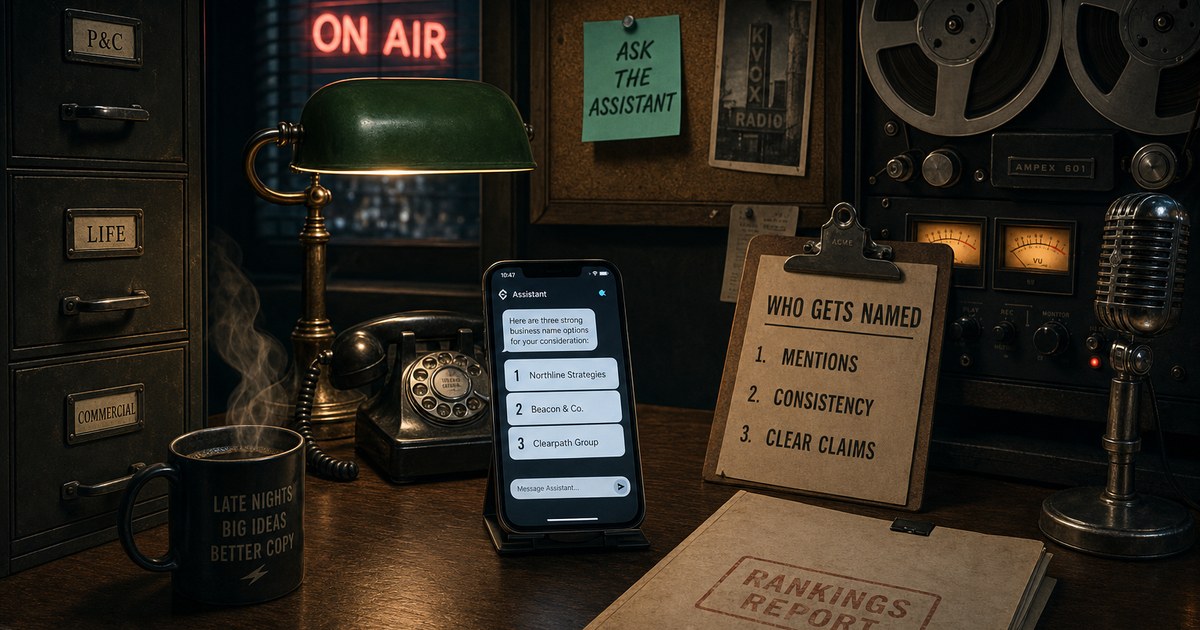
Forty-five percent of consumers used an AI tool to find a local business in the past year, up from six percent. The assistant now builds the shortlist before the buyer opens a results page, and only twelve percent of the pages it cites rank in Google's top ten for the same question.
TL;DR
Forty-five percent of consumers used an AI tool to find a local business in the past year, up from six percent twelve months earlier. The assistant builds the shortlist before the buyer ever sees a results page, and the inputs it reads are not the inputs that drive your Google rank. Run the query yourself, fix every contradiction the open web tells about your agency, and measure the channel apart from organic.
Forty-five percent of consumers used an AI tool to find a local business in the past year, up from six percent twelve months earlier, according to BrightLocal's Local Consumer Review Survey 2026. Over the same period, the share of consumers using Google to find and read information about local businesses fell from eighty-three percent to seventy-one percent.
That is a twelve point swing in one year. By the end of this you will know what the new decision layer actually reads, why your Google rank does not carry into it, and what to check about your own agency today.
Key Takeaways from the AI recommendation shift?
- 45% of consumers used an AI tool to get a local business recommendation in the past year, up from 6% the year before, and 64% of those aged 30 to 44 have done it.
- Only 12% of URLs cited by ChatGPT, Gemini, and Copilot rank in Google's top 10 for the same prompt, so ranking and being recommended are two separate competitions.
- Branded web mentions correlate with AI visibility about three times more strongly than backlinks, 0.664 against 0.218 across 75,000 brands.
- 63% of active AI users trust AI recommendations for local businesses, and 88% verify them against reviews or sources before acting.
- AI referral traffic is a low single digit share of sessions, but those visitors are worth about 4.4 times a standard organic visitor by conversion rate.
How many buyers are actually asking an AI before they call an agency?
Start with the number that frames everything. BrightLocal surveyed 1,002 US adults and found 45% had used an AI tool such as ChatGPT, Gemini, or Perplexity to get a local business recommendation in the past year. The same question a year earlier returned 6%. That puts AI third among local discovery channels, behind Google and Facebook, ahead of Yelp and Tripadvisor (BrightLocal, 2026).
The age split matters more than the headline if you write personal lines. 64% of consumers aged 30 to 44 have asked an AI for a business recommendation, against 24% of those 60 and over (BrightLocal, 2026). That band is household forming, mortgage carrying, two vehicles, umbrella eligible. It is the book you are trying to build.
The base underneath it is not in dispute. Insurity's 2026 AI in Insurance Report found 84% of Americans use AI tools at least occasionally and 27% use them daily (Insurity, 2026). On the business side, the Census Bureau's Business Trends and Outlook Survey has tracked AI adoption by US firms every two weeks since 2023, and the curve has only gone one direction.
The carrier-side research says the same thing. JD Power's 2026 U.S. Insurance Shopping Study found shoppers pulling more quotes because AI makes comparison easier, and that AI users are more likely to switch and more confident in the choice. Confident buyers, moving fast, off a list you may not be on. We covered the wider shift in AI Is Reshaping Insurance Sales: Will Your Agency Adapt or Become Obsolete?.
None of that is a forecast. It already happened.
What happens when the assistant answers and your agency is not in it?
You do not get a bad position. You get no position, and no record that the conversation happened.
Pew Research Center tracked 68,879 real Google searches across more than 900 US adults in March 2025. When an AI summary appeared, users clicked a traditional result 8% of the time, against 15% without one. About 1% clicked a link inside the summary, and users abandoned browsing entirely after a page with a summary 26% of the time, against 16% without (Pew Research Center, 2025).
Zero click search is not new. What changed is how few names the answer contains.
Read that as an operator. The answer is the shortlist. If three agencies get named and you are not one of them, the prospect never sees your site and never registers as a lost deal anywhere in your reporting. There is no impression to count. The loss is invisible by construction, which is why most owners have not noticed it.
Trust in that shortlist is high enough to act on. BrightLocal found 63% of active AI users trust AI recommendations for local businesses, with only 10% expressing distrust. 64% of AI users now trust tools like ChatGPT as much as traditional reviews when choosing a local business.
Most still check the work. 88% of AI users verify what they are told against sources or reviews before acting on it. That is the useful detail. The assistant is not closing the deal, it decides who gets considered, and the buyer verifies from there. Getting on the list is the whole game.
Why does an assistant pick one agency over another?
Because it runs a different retrieval system. That system reads the open web as a description of your agency, not as a ranking of pages.
When someone asks for the best insurance agent in a city, the assistant assembles an entity picture from whatever it can reconcile: your website, mentions on sites you do not control, directory records, review platforms, press and podcast pages. BrightLocal's analysis of ChatGPT Search sources for local queries found business websites at 58%, business mentions at 27%, and directories at 15% (BrightLocal). Your own site is the largest single input, and it is not the majority.
That explains the signal that keeps surfacing in citation research. Ahrefs studied 75,000 brands in August 2025 and found branded web mentions correlate with AI Overview visibility roughly three times more strongly than backlinks, 0.664 against 0.218 (Ahrefs, 2025). Links move rankings. Mentions move recommendations.
Why does contradictory business information get you dropped?
It also explains the failure mode. When sources disagree about your address, service area, lines written, or legal name, the model has nothing stable to state. It leaves you out, or it repeats whichever version appeared most often, usually the oldest. Contradiction does not read as nuance to a retrieval system. It reads as low confidence, and low confidence businesses do not get named.
One more structural difference. Answers are generated, not stored. Ask the same question three times and you can get three different lists. You cannot hold position one the way you hold a ranking. You can become the entity the model reaches for often enough to show up in most runs.
That is a different job than SEO, and even the low risk plays in 3 Quick AI Wins Every Agent Can Deploy With Zero Compliance Risk assume somebody has looked first. It is also a different job than buying the software, which is the trap in Your Agency Bought AI Nobody on Staff Knows How to Use.
Which agencies show up in AI answers, and which top ranked ones do not?
This is where the dashboard lies to you. Ranking and being recommended are two separate competitions now, and the overlap is smaller than almost anyone assumes.
Ahrefs analyzed 15,000 prompts and found that on average only 12% of URLs cited by ChatGPT, Gemini, and Copilot appeared in Google's top 10 for the same prompt. Perplexity was the outlier, with nearly one in three of its citations pointing to a top 10 page (Ahrefs, 2025).
Now the local version, the one that should move your budget. SOCi's 2026 Local Visibility Index analyzed more than 350,000 locations across 2,751 multi-location brands. In retail, only 45% of the brands leading traditional local search also appeared among the most recommended in AI results. Across the study, ChatGPT recommended 1.2% of locations while those same brands appeared in Google's local three pack 35.9% of the time.
How can a top ranked agency be invisible to ChatGPT?
Picture two agencies in the same zip code. Same carriers, same lines, same size book.
Agency A owns the map pack. Bought the local SEO package in 2019, immaculate Google Business Profile, first for the obvious keyword. Ask ChatGPT which agency to call in that city and Agency A never comes up. The model found a thin website and one stale directory entry with a dead number. Nothing to reconcile means nothing to say.
Agency B ranks fourth on a good day. But the owner has done three podcasts, got quoted in a local business journal piece on rate increases, sits on a chamber page, has consistent listings across six platforms, and runs a site that states which lines it writes and which counties it covers. Agency B gets named.
Both owners get a report at month end. Agency A's says everything is fine. Agency B's says rankings need work. Both reports are accurate. They measure different competitions, and only one is the competition buyers are running now.
How should an insurance agency get into the answer?
Five moves, in order. The first is free and takes ten minutes.
Run the query yourself. Open ChatGPT, Gemini, and Perplexity and ask what your buyer asks: best insurance agent in your city, cheapest home and auto in your town, who to call for a small business policy. Ask each three times, because output varies. Write down who gets named, what is said about you, and where the assistant says it got the information. That last column is your repair list.
Fix the contradictions before publishing anything new. Make the facts identical everywhere the web describes you: legal name, phone, address, hours, lines written, service area, carriers. Abandoned profiles and decade old directory entries are the usual culprits. It is unglamorous, and it is the highest yield hour you will spend this quarter, because the selection mechanics in this breakdown of how ChatGPT decides which businesses to recommend reward consistency far more than volume.
What kind of page does a model actually quote?
Write pages that answer questions directly. A model extracts claims. "We write home, auto, and umbrella in Pima County and have since 2011" is extractable. "Your trusted local partner for all your insurance needs" is not. State what you write, where, and for whom.
Earn mentions off your own domain. Mentions are 27% of what ChatGPT Search pulls for local queries and correlate with AI visibility about three times more strongly than backlinks. Local press, association directories, podcast appearances, chamber pages, review platforms beyond Google. Ten mentions a human would recognize beat a hundred anonymous backlinks.
Measure it separately or you will never see it. AI referral traffic is still a low single digit share of sessions on most sites, small enough to ignore until you see what it does on arrival. Semrush found AI search visitors are worth about 4.4 times a traditional organic visitor when measured by conversion rate (Semrush via PPC Land, 2025). Most of it lands in the direct bucket in GA4 and disappears. Build the channel group, then judge it on close rate, not sessions.
What is the bottom line on AI recommendations for insurance agencies?
The decision layer moved and the scoreboard did not follow it. Your rank report still grades the old competition.
Agencies spent twenty years optimizing for a results page. 45% of consumers now start somewhere that page never renders, and that number was 6% a year ago. The competition to be named in an AI answer runs on different inputs than the competition to rank, overlaps with it by 12% or less depending on the study, and sits near uncontested in most local insurance markets because almost nobody has checked.
None of this requires a budget or a vendor. It requires ten minutes to run the query, a day to fix what contradicts itself, and the discipline to report the channel apart from organic. Do it this quarter and you are buying position while the bar is on the floor. Wait, and you do identical work in eighteen months against competitors whose entity is already built and already getting named.
Go ask an assistant what it says about your agency. Whatever comes back is what your next prospect is reading.
Sources cited in this analysis?
- BrightLocal - Local Consumer Review Survey 2026
- BrightLocal - Half of Consumers Are Asking AI for Business Recommendations
- BrightLocal - Local SEO Statistics, including ChatGPT Search source analysis
- Pew Research Center - Google Users Are Less Likely to Click on Links When an AI Summary Appears in the Results, July 2025
- Ahrefs - Only 12% of AI Cited URLs Rank in Google's Top 10 for the Original Prompt
- Ahrefs - An Analysis of AI Overview Brand Visibility Factors, 75,000 Brands, August 2025
- Insurity - 2026 AI in Insurance Report
- US Census Bureau - Business Trends and Outlook Survey, AI use by firms
- Semrush via PPC Land - AI Search Visitors Worth 4.4x More Than Traditional Organic Traffic, June 2025
- SOCi - 2026 Local Visibility Index, 350,000 locations across 2,751 multi-location brands
- JD Power - 2026 U.S. Insurance Shopping Study
Listen to The Insurance Dudes Podcast
Get more strategies like this on our podcast. Available on all platforms.
Related Episodes
Your Agency Bought AI Nobody on Staff Knows How to Use

Avdhesh Saxena on AI Chatbots Changing Insurance (Part 1)
Avdhesh Saxena on Implementing the Friendly Agent Bot
Dan Faggella: How AI Will Transform Insurance Agencies

How RiskGenius Is Using AI to Transform Insurance Docs
