Do Sales Scripts Work for Insurance Agents? Pros and Cons
Craig and Jason are licensed P&C agency owners, co-authors of Million-Dollar Agency, creators of the trademarked Telefunnel, hosts of The Insurance Dudes podcast, and speakers.
Written and reviewed under our editorial process. Found an error? See our corrections policy.

Sales scripts work for insurance agents when built right and drilled to fluency. A strong script needs five components: an opener that hooks attention, discovery questions that actually discover, a bridge from need to solution, pre-thought objection paths, and a close that explicitly asks. Fluency requires volume, not just reading.
Sales scripts work for insurance agents when they are built from real conversations and drilled to fluency. The agents closing at the highest rates all have a script. They have internalized it so completely it sounds natural. "Pre-Script-Shun" is Jason Feltman's name for the reflex that costs agents the consistency and coaching precision a proper framework provides.
What does "Pre-Script-Shun" actually mean for insurance agents?
The title of this episode is a pun with a point. "Pre-Script-Shun" is a prescription for your script. Before you dismiss the script entirely or defend it blindly, you need a prescription: a deliberate, clinical decision about what your script should do, where it should be rigid, and where it should flex.
Most agency script problems aren't script problems. They're either prescription problems (the script was written without clarity about its job) or training problems (the script was handed over without the repetitions required to make it fluent). A poorly written script that gets drilled 500 times will outperform a brilliant script that gets used twice.
This solo episode comes from a place of practical frustration. Too many agents are winging calls that should be structured, and they're losing sales they should be closing. Too many agency owners have given up on scripts because one staff member sounded stiff on a recorded call. The answer is not to abandon the script. The answer is to get the prescription right.
What is a sales script actually for, and what must a good one include?
A script is not a reading assignment. A script is a map of a proven path from the beginning of a conversation to a closed sale, built from the patterns that work and stripped of the fumbling that doesn't.
When you're new, a script prevents you from reinventing the wheel on every call and losing momentum when the conversation takes a turn you haven't navigated before. When you're experienced, a script is the underlying structure that your natural conversational style fills in. The rhythm you've internalized so thoroughly that deviating from it actually costs you.
The highest-performing sales professionals in every industry use scripts. What varies is how conscious they are of it. The actor who has run a role for six months doesn't feel like they're reciting lines, but the lines are still there. The musician who has played a song a thousand times isn't thinking about the notes, but the notes are still there. The insurance agent who has closed 2,000 policies isn't consciously following a script. But the structure of that conversation is not random.
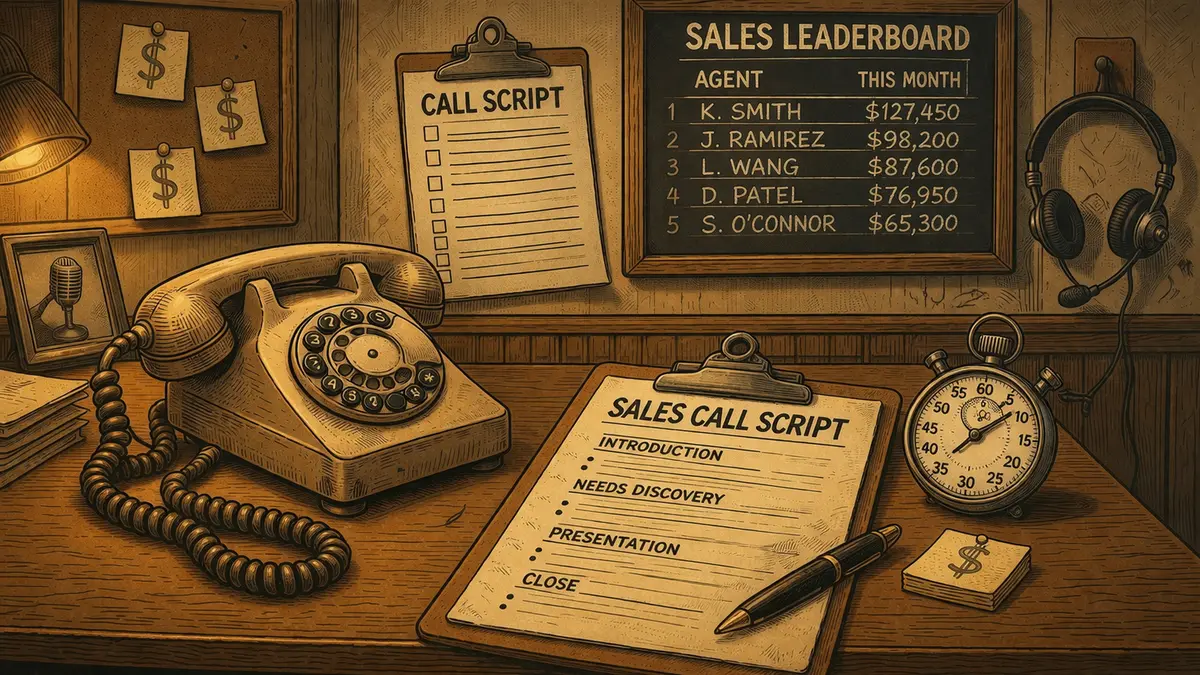
What a good insurance sales script must include:
-
An opening that earns the next thirty seconds. Not a feature dump. Not a price announcement. Something that hooks the prospect's attention and signals that this conversation is about their situation, not your pitch.
-
Discovery questions that actually discover. Not box-checking. Not product education disguised as questions. Real inquiry about what the client currently has, what's happened to them, what they're worried about, and what they'd change if they could.
-
A bridge from need to solution. The moment where you connect what they just told you to what you're about to recommend. This is the most-skipped part of most insurance sales scripts and the most powerful.
-
Objection paths that have been pre-thought. Every common objection (price, timing, carrier loyalty, "I need to talk to my spouse") should have a prepared response that has been tested and refined, not improvised on the fly while the call is happening.
-
A close that actually asks. Many agents arrive at the end of a good conversation and then trail off, hoping the client will volunteer to buy. The script should include an explicit ask. Not high-pressure, just clear. There's a difference.
Why do scripts fail in most agency settings, and how do you fix it?
Here's the real reason scripts fail in agency settings: agents are handed a script and given insufficient time to achieve fluency before they're put on live calls. Reading a script is not using a script. Using a script means the words come out naturally because you have said them enough times that they've become your words.
How many repetitions does that take? More than most managers want to invest in and fewer than most agents think. Role-playing ten calls is not the same as role-playing a hundred. The research on skill acquisition is clear: fluency requires a volume of practice that most agency training programs don't provide.
The prescription: write the script, drill it in role-play until it's natural, record the calls, compare them to the script, identify the gaps, drill again. This is not glamorous. It's how top agents get made.
How do you diagnose the script problem in your agency this week?
If you have producers who are getting through quotes but not closing, the first diagnostic question is whether they have a real script or just loose talking points. If the answer is talking points, you have a prescription problem to fix.
If you have a script that your team is using but the close rates are still low, listen to recorded calls and identify exactly where the conversation is going off track. Is it the opening? The discovery? The bridge? The close? The script problem is almost always in one specific place, and finding that place makes the fix surgical rather than speculative.
Scripts are not magic. They're infrastructure. Like any infrastructure, they require proper installation and ongoing maintenance.
Do sales scripts actually work for insurance agents?
The prescription for sales scripts isn't to use them or abandon them. It's to understand what they're for, build them properly, and drill them to fluency. The agents who do that stop sounding scripted. They start sounding like they know exactly what they're doing. Because they do.
Catch the full conversation:
Level up your agency:
Listen to The Insurance Dudes Podcast
Get more strategies like this on our podcast. Available on all platforms.
Related Episodes
Why Sales Scripts Work for Insurance Agencies (and How)
5 Psychology Principles Every Insurance Agent Needs to Know
NLP Techniques for Insurance Sales: Matching and Mirroring
Top 2 Phrases That Give You Raises in Insurance Sales
Active Listening: Why You're Retaining Only 25% of Clients
