Why Sales Scripts Work for Insurance Agencies (and How)
Craig and Jason are licensed P&C agency owners, co-authors of Million-Dollar Agency, creators of the trademarked Telefunnel, hosts of The Insurance Dudes podcast, and speakers.
Written and reviewed under our editorial process. Found an error? See our corrections policy.
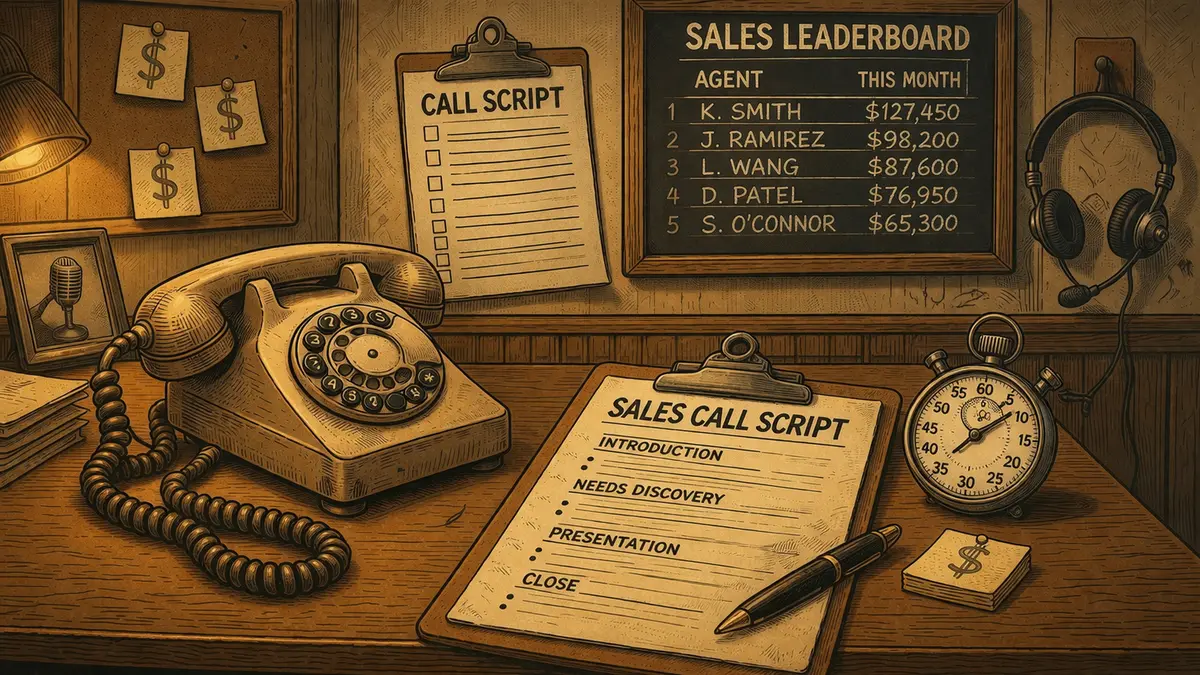
Sales scripts work for insurance agencies because every top-producing agent already uses one. They have just internalized it. Build the framework from your best conversations, drill it to fluency in role-play, and deploy it on live calls. Close rate, training speed, and coaching precision all improve.
Sales scripts work for insurance agencies. Every top-producing agent already uses one. They have internalized it so completely it sounds natural. "Pre-Script-Shun" is the instinct to dismiss scripts before giving them a fair evaluation, and it costs agencies sales, training consistency, and coaching precision every single month.
What is a sales script actually for in an insurance agency?
The word "script" conjures an image of a call center agent reading word-for-word from a sheet of paper in a monotone voice while staring at a screen. That's not what an effective sales script is, and the confusion between those two things is at the root of most agents' resistance.
An effective script is a framework. It's the structure of a successful conversation: the sequence of questions to ask, the key points to make, the objections to expect and the responses that work, the call to action that closes the loop. It's not a verbatim transcript. It's a map. The reason you want a map is not because you can't navigate without one. It's because the map ensures you don't miss anything important, regardless of how the conversation goes.
Every experienced, successful insurance agent has a script. They may not call it that. They may not have it written down. But if you asked them to walk you through a typical successful sales conversation, they would describe the same sequence of steps every time, because that sequence has been refined through hundreds or thousands of reps into something that reliably produces good outcomes. That's a script. The difference between them and the agent who claims to have no script is that they've internalized their framework so completely it feels natural. They haven't achieved some superior free-form conversational mastery.
What does an insurance agency actually lose by running without a script?
When your agency has no defined scripts, every conversation is a fresh improvisation. Some improvisations go well. Many do not. The variability in outcomes reflects the variability in the conversations, and that variability is almost never in the client's favor. Without a framework, agents miss qualification questions. They forget to explain key coverage points. They fail to address the most common objections because they haven't prepared for them. They don't have a clear call to action so conversations end ambiguously.
This variability becomes catastrophic when you're trying to scale. When you bring on a new team member, what do you teach them? How do you train a new producer if there's no documented framework for what a good sales conversation looks like? The honest answer, in agencies without scripts, is that you're mostly teaching by osmosis. You're hoping the new person absorbs the right patterns by sitting next to experienced agents and picking things up over time. This is slow, inconsistent, and wildly inefficient.
Scripts make training possible. They make quality control possible. They make it possible to identify where a conversation broke down and coach specifically to that failure. "You didn't acknowledge the objection before responding to it. Here's how to do that" is coaching. "That call didn't go well, work on it" is not.
How do you build a script that sounds like natural conversation?
The goal of a script is to be so internalized that it doesn't sound like you're reading from one. Getting there requires three things: a well-built script, deliberate practice, and volume.
Well-built means tested. The best scripts are built from the conversations that actually worked. Take your best performers (or yourself on your best days) and document what they do. What questions do they ask at the beginning of a conversation? How do they handle price objections? What do they say when a client says they need to think about it? Build the script from evidence, not theory.
Deliberate practice means roleplay. The reason most scripts feel robotic when agents first use them is not that scripts are inherently robotic. It's that the agent hasn't done enough reps to internalize the language. Reading lines from a piece of paper sounds like reading lines from a piece of paper. Having done 50 roleplays of the same conversation until the words are completely natural sounds like normal conversation. The work is the reps, not the words.
Volume means real calls. Roleplay builds the foundation. Actual calls build the fluency. New agents should be doing a high volume of calls specifically to get reps on the script, with a debrief after each session on where they deviated and why.
Which stages of the client journey need their own script?
Most agencies, if they have any scripts at all, have them for the initial sales call. That's a starting point, but the script library shouldn't stop there.
Scripts for the service call: how to open, how to do a mini coverage review, how to cross-sell without being awkward. Scripts for the renewal conversation: how to review, how to address premium increases, how to retain at-risk clients. Scripts for claims assistance: how to be genuinely helpful in a stressful moment in a way that builds loyalty. Scripts for referral requests: how to ask without it feeling transactional.
Each of these touchpoints is an opportunity to deliver a consistent, excellent experience. Alternatively, an inconsistent, mediocre one. Scripts are the infrastructure for consistency.
What is the first script-building step for your agency this week?
Pick one conversation your agency has dozens of times a month. Write down what a perfect version of that conversation looks like: the opening, the key questions, the most common objections and the best responses, and the close. Share it with your team. Practice it. Track whether conversations that follow the framework produce better outcomes than those that don't. The evidence will make the case.
Should every insurance agency be using sales scripts?
Pre-script-shun is an expensive habit. The agents who resist scripts aren't protecting their authenticity. They're protecting a comfortable improvisation that's producing inconsistent results. Build the framework, do the reps, get natural with it. Your close rate, your client experience, and your team's ability to develop will all improve.
Catch this episode:
Level up your agency:
Listen to The Insurance Dudes Podcast
Get more strategies like this on our podcast. Available on all platforms.
Related Episodes

Do Sales Scripts Work for Insurance Agents? Pros and Cons

Brian Ahearn on Selling Insurance Without Feeling Pushy
Brian Ahearn Closes Out the Influence Playbook (Part 2)
The Script Proposal: Better Sales Language That Closes
The Price Is Right: Pricing Talks That Don't Kill the Deal
