Why New Producers Fail the Insurance Licensing Exam
Craig and Jason are licensed P&C agency owners, co-authors of Million-Dollar Agency, creators of the trademarked Telefunnel, hosts of The Insurance Dudes podcast, and speakers.
Written and reviewed under our editorial process. Found an error? See our corrections policy.
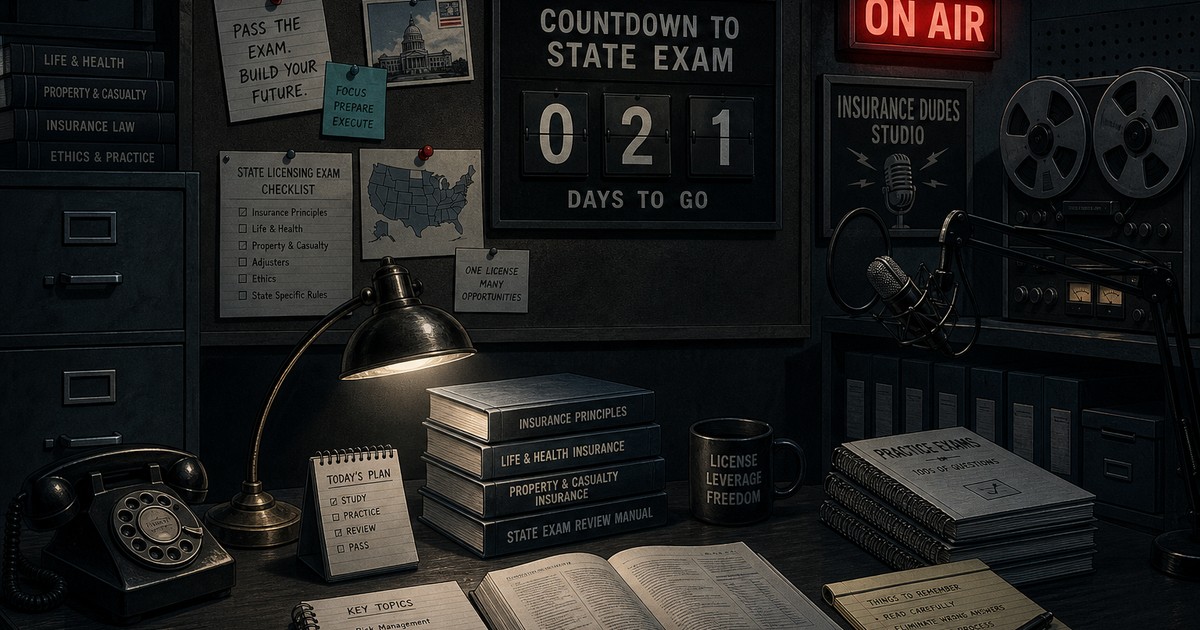
New producers fail the licensing exam because owners leave them alone with a study manual and no structure. A four week prelicensing sprint with daily practice tests, one fixed test date, and a mentor reviewing every wrong answer gets a producer licensed fast and on the phones. The exam is an onboarding problem, not a candidate problem.
TL;DR
Your new producer is not failing the licensing exam because insurance is too hard. They are failing because you handed them a manual and walked away. A four week prelicensing sprint with daily practice exams, one fixed test date, and a mentor who reviews every wrong answer gets a producer licensed fast. It also gets them on the phones before the recruiting cost sinks into nothing. This is an onboarding problem, not a candidate problem.
Key Takeaways from the licensing exam?
- New producer failure runs near 70 to 80 percent, and the licensing exam is the first drop-off in that funnel.
- A producer who cannot write business is costing you money, so every week of unlicensed study is paid cash with zero revenue.
- Three moves cut exam time in half: daily practice tests, a fixed test date on the calendar, and a mentor who reviews every missed question.
- The producer should not study alone, and shadowing live calls while they study keeps them connected to the shop.
The licensing exam is the first real filter in your hiring funnel. It is also the first place you can win or lose a producer in under 30 days. Most owners treat it as the candidate's problem and pay for the miss later.
Why do new producers fail the licensing exam?
New producers rarely fail the exam on the material. They fail on structure. Left alone with a prelicensing course and no deadline, a producer studies in fits, stalls for weeks, and walks into the test underprepared and ashamed of it. The failure shows up on the exam but it was created in the onboarding plan you never wrote.
The industry failure rate for new producers is brutal. Chris Burand, president of Burand and Associates, estimates the new producer failure rate as high as 70 to 80 percent, with other estimates near 50 percent (Insurance Journal, April 2020). The licensing exam is not the whole story, but it is the first door. A producer who sits for months before passing is a producer who quits before they ever write a policy.
The cost side is just as sharp. A producer who cannot legally write business is overhead you are funding with no revenue in return. Every week a candidate spends stuck on the exam is paid salary, benefits, and your training energy with nothing bound. That math is why the exam has to be treated like a sprint, not a slow self-study project.
"A new producer who passes the state exam knows the regulations, but nobody has taught them to sell or run a renewal yet. The missing piece is the structured transition from licensed to competent, and that transition is the owner's job to build." - Craig Pretzinger, Agency Owner, The Insurance Dudes
How long does it take to get an insurance license?
With structure, a candidate can go from zero to licensed in about four weeks. Without it, the same candidate drifts for two to three months and may never close the gap. The variable is not IQ or study hours. It is whether someone schedules the test date and tracks the daily progress.
Most states require a prelicensing education course, then a proctored exam with a passing score that varies by line and state. The exact rules live with your state department of insurance, and the Federal Insurance Office tracks the national producer licensing structure that every agency shares. The takeaway for an owner is simple: the exam is a known, fixed gate, which means it can be planned around.
Set the test date on day one. Put it four weeks out. Then work the study plan backward into daily practice blocks. A date on the calendar turns a vague goal into a constraint, and a constraint is what finishes the work.
What is the prelicensing sprint that actually works?
The sprint has three parts, and none of them are optional. First, the producer runs a practice exam every single day from week one, and the score gets recorded. A daily practice score is a leading indicator, so you see a failing candidate at week two instead of week six. Second, a mentor reviews every missed question the same day, because the review is where the learning happens, not the reading. Third, the producer shadows live calls for two hours each morning while they are still studying.
That last piece is the one most owners skip. The producer is not studying in a vacuum. They hear the opener, the objection loop, and the close before they ever pick up the phone. By the time they pass, they have listened to real conversations and the exam no longer feels like the whole battle (Insurance Journal, April 2020). We walk through the full 90-day version of this in our producer retention breakdown.
The sprint also protects your recruiting spend. A producer who passes in four weeks is producing in month two. A producer who fails twice and quits is a sunk cost with nothing to show for it. That is the same risk we flag in our guide to recruiting producers who do not quit in 90 days.
Why does structure beat raw effort on the exam?
Effort without a deadline leaks into scrolling. Structure without effort is a checklist. The sprint needs both, but most owners supply neither and then blame the candidate when the test comes back failed. The fix is to treat exam prep like dialing quotas: measured daily, reviewed by someone, and tied to a consequence.
The agencies that win here are the ones with a documented system. Reagan Consulting has tracked top performing agencies for over three decades, and the Best Practices firms share one trait, which is that they run their people through repeatable, measured processes instead of winging it (Reagan Consulting, Best Practices). The 2026 Best Practices Study update from the Big I and Reagan Consulting shows the same firms still lead on staff productivity and retention (IA Magazine, 2026). A licensing sprint is exactly that kind of repeatable process.
Give the producer a scoreboard. Practice score, days to test, wrong-question count. When they own one number and a mentor checks the trend, the exam stops being a mystery and becomes a date on the calendar. The training habit does not stop at the exam either, because licensed producers return for continuing education on the same structured rhythm (PropertyCasualty360, CE Training).
How do you recover a producer who already failed the exam?
A first failure is not a firing event. It is a signal that the study plan was missing something. Most candidates can pass on the second attempt when you fix the gap instead of just rescheduling them. Find the line of authority they missed questions on, drill it for two weeks, and book the retake the moment the practice scores stabilize above the passing line.
That said, do not let a failing producer study alone again. The definition of a bad plan is doing the same thing and expecting a different result. Pair them with the mentor who reviewed their first run and rebuild the sprint around the specific weakness. A candidate who fails once and passes on the structured second attempt is often more committed than the one who squeaked through the first time. For the bigger picture on what a failed hire really costs you, see our breakdown of the bad producer hire.
What is the bottom line on the licensing exam?
The licensing exam is not a test of your candidate. It is a test of your onboarding system. A structured four week sprint with daily practice tests, one fixed date, and a mentor who reviews wrong answers turns a two month drift into a four week finish. The producer gets on the phones faster, and your recruiting dollar stops bleeding on someone who cannot yet write business.
Sources cited in this analysis?
Listen to The Insurance Dudes Podcast
Get more strategies like this on our podcast. Available on all platforms.
Related Episodes
Why Insurance Agents Quit in Year One and How to Keep Them

Dave Williams: What Happens After the Offer Letter (Part 2)

How to Onboard New Insurance Agency Team Members Right
Turn Hiring Nightmares Into a 5-Step System That Works
7 Sales Mistakes Costing Your Insurance Agency Real Revenue