Three Swings: Turn One Policy Into a Whole Household
Craig and Jason are licensed P&C agency owners, co-authors of Million-Dollar Agency, creators of the trademarked Telefunnel, hosts of The Insurance Dudes podcast, and speakers.
Written and reviewed under our editorial process. Found an error? See our corrections policy.
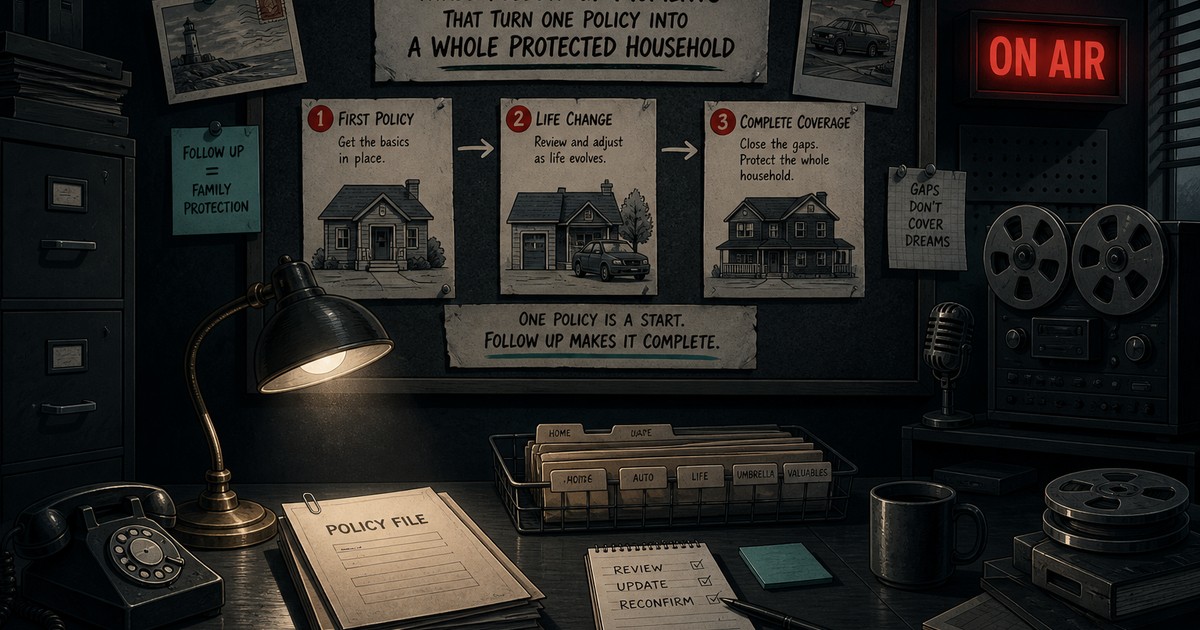
Every policy you sell is the first brick in a household you never finished building. The Three Swings mean three follow-ups at 48 hours, one week, and 45 days before renewal. Each swing closes a gap you already know exists, and households with three or more policies retain far better than monoline accounts.
TL;DR
The policy you just sold is not a finished account. It is the first brick in a household that is still missing coverage, and every gap you leave open is a reason that client shops you a year from now. Three timed follow-ups after the sale turn one policy into three, and a three-policy household renews at a rate a monoline account cannot touch.
Key Takeaways for rounding a household?
- Bundled home and auto accounts retain far better than monoline accounts, and each added policy deepens the switching cost that keeps a household on your book.
- Only about half of consumers even know their multiline carrier offers life insurance, so the gap is awareness, not demand.
- A healthy cross-sell book sits near 2.8 policies per household, not the single line you wrote on day one.
- Three timed swings at 48 hours, one week, and 45 days before renewal catch the coverage gaps before the carrier does.
The sale you closed this morning is a single line on a client who owns a house, a car, and a family. You wrote one of those. The other two are sitting on someone else's book, and every month they stay there, the reason they have to stay with you gets thinner.
What is the Three Swings system?
The Three Swings is a post-sale development sequence with three timed follow-ups. The first happens 48 hours after the sale, the second one week later, and the third 45 days before the first renewal. Each swing has one job: catch the coverage gap you already know exists and close it before the client shops around. It is not a drip campaign and it is not a surprise. It is a schedule you put on the calendar the day the policy binds.
Most agency owners treat the sale as the finish line. They close the auto, send the paperwork, and wait for the renewal to show up. That is a monoline habit, and it fills the book with single-policy accounts that quietly churn.
The data makes the cost plain. Cross-selling that rounds a single line into a household measurably lifts retention and profit, a pattern PropertyCasualty360 has tracked for years, because each added policy gives the household another reason to stay. A rounded account is the difference between a book that compounds and a book you have to resell every year.
Why does a single policy cost you more than a household?
A monoline account costs you twice. First, you paid the full acquisition cost to win that client, and you only get to amortize it across one thin commission stream. Second, that client has no switching friction, so one quote from a competitor can take them because nothing else ties them to you.
When you round the account, the math flips. Cross-selling improves retention and strengthens the relationship, because each added policy is another reason the client has to stay, as PropertyCasualty360 has argued for years. A three-policy household has three renewal dates, three check-in moments, and three reasons not to move the book to a stranger.
This is the same principle behind our client retention playbook and the lifetime value math that every owner should track. The household is the buying unit, not the policy, and you leave money on the table every time you stop at one line.
What happens in the first swing at 48 hours?
The first swing is a check-in, not a pitch. You call or text two days after the sale to confirm the documents are signed, the payment landed, and the proof of insurance is saved on their phone. That is the whole job. You are not selling here, and that is the point.
Here is why this swing matters more than it looks. Cancellations inside the first 30 days are far more common when nobody follows up, because buyer's remorse and missing paperwork turn into silent churn. A 60-second check-in kills that risk while the client is still warm. While you have them, you seed the next step: tell them you will call back in a week to walk through the rest of their household. You set the expectation up front, so the second swing never feels like a cold call from a stranger.
What happens in the second swing at one week?
The second swing is the offensive move. You call back a week later and ask for ten minutes to check the rest of the household. This is where you attack the monoline gaps, quote the auto and home bundle, and start the life or umbrella conversation based on what you learned in the first call. It is the moment our policy review playbook is built to land, because a review turns a cold reach-out into a conversation about what is still missing.
The opportunity lives in the gap between what the client owns and what they have covered. Rough Notes puts a well-rounded book near 2.8 policies per household, and most of your book is probably sitting at one. You do not need a script for this. You need the household picture: the spouse's car, the second driver, the boat, the umbrella, the term life on the mortgage. Each one is a swing, and each one is a reason they cannot leave you cleanly.
"Rounding an account increases retention exponentially. Decades of statistics show the accounts that stay are the ones with the most coverage woven through them, not the ones with the best rate on a single line." - Agency operations guidance from Rough Notes on intentional retention.
Why do most owners miss the life insurance cross-sell?
Life is the cross-sell that almost nobody tries, and it is usually not because the client said no. LIMRA found that only about half of consumers are even aware their multiline carrier offers life insurance. The client is not refusing the product. They literally do not know you sell it.
That turns the life conversation from a hard pitch into a simple disclosure. During the second swing, you ask one question: if something happened to the primary earner, is the mortgage covered? The answer opens a term life conversation that requires no persuasion, because you are filling a gap they did not know they had. The owner who never brings up life leaves the single most persistent revenue stream on the table every single household.
What happens in the third swing at 45 days before renewal?
The third swing is the retention close. Forty-five days before the first renewal, before the carrier mails the rate increase, you call to re-pitch whatever you did not close in the second swing. By the time the renewal letter arrives, the client has either already rounded the account or knows you are the one checking in ahead of the price change.
Timing is the entire game here. If the carrier's rate increase hits the mailbox before your call, the client is already dialing a competitor. If your call lands first, you own the frame and the umbrella or life conversation just became a retention move instead of a sales pitch.
This is also where the account-rounding economics compound. Raising retention by even five points can lift profit by as much as 50 percent, a figure Rough Notes ties directly to proactive cross-selling, and Harvard's customer retention research confirms retention is the lever that most directly drives firm profitability. In fact, the pre-renewal call is the exact moment this swing is designed to win, and it is the most underused move on the retention calendar.
How do you put the Three Swings on autopilot?
You do not remember to do this. You calendar it. The day a policy binds, three dated tasks go on the calendar for that household: plus two days, plus one week, and 45 days before the first renewal date. Each task has a specific action and a specific goal, so the follow-up is not a vague "call John sometime."
That is the whole system, and it is why it works for a busy owner. You are not adding a sales process. You are adding three dates to a calendar that already runs your week. The client gets three quick check-ins instead of one hard renewal pitch, and you get a rounded household instead of a single line. The retention math does the rest, year after year, without you having to resell the same book every renewal cycle.
What is the bottom line on turning one policy into a household?
You do not need a bigger budget or a better pitch to grow your book. You need a schedule. Three timestamps after the sale, at 48 hours, one week, and 45 days before renewal, turn a single line into a household and lift retention from monoline to bundled territory without a single new lead. The book compounds when the follow-up is already on the calendar before the sale even closes.
Sources cited in this analysis?
- LIMRA survey finds only half of consumers aware their multiline carrier offers life insurance (2011)
- Facts and statistics on homeowners and renters insurance - Insurance Information Institute
- The importance of the cross-sell - Rough Notes
- Intentional retention - Rough Notes
- Cross-selling 101 - PropertyCasualty360 (August 2014)
- Best practices study - Reagan Consulting
Listen to The Insurance Dudes Podcast
Get more strategies like this on our podcast. Available on all platforms.
Related Episodes

Agency Growth Bottleneck: Your Book Stalls at Your Desk

How to Pick an Insurance Agency Growth Strategy That Works

Why Insurance Agents Quit in Year One and How to Keep Them

The Agency Growth Math: Cost Per Sale vs. Lifetime Value

Captive Agency Growth Architecture: The Systems That Scale