Kian Gohar on Why AI Makes Human Skills More Valuable
Craig and Jason are licensed P&C agency owners, co-authors of Million-Dollar Agency, creators of the trademarked Telefunnel, hosts of The Insurance Dudes podcast, and speakers.
Written and reviewed under our editorial process. Found an error? See our corrections policy.
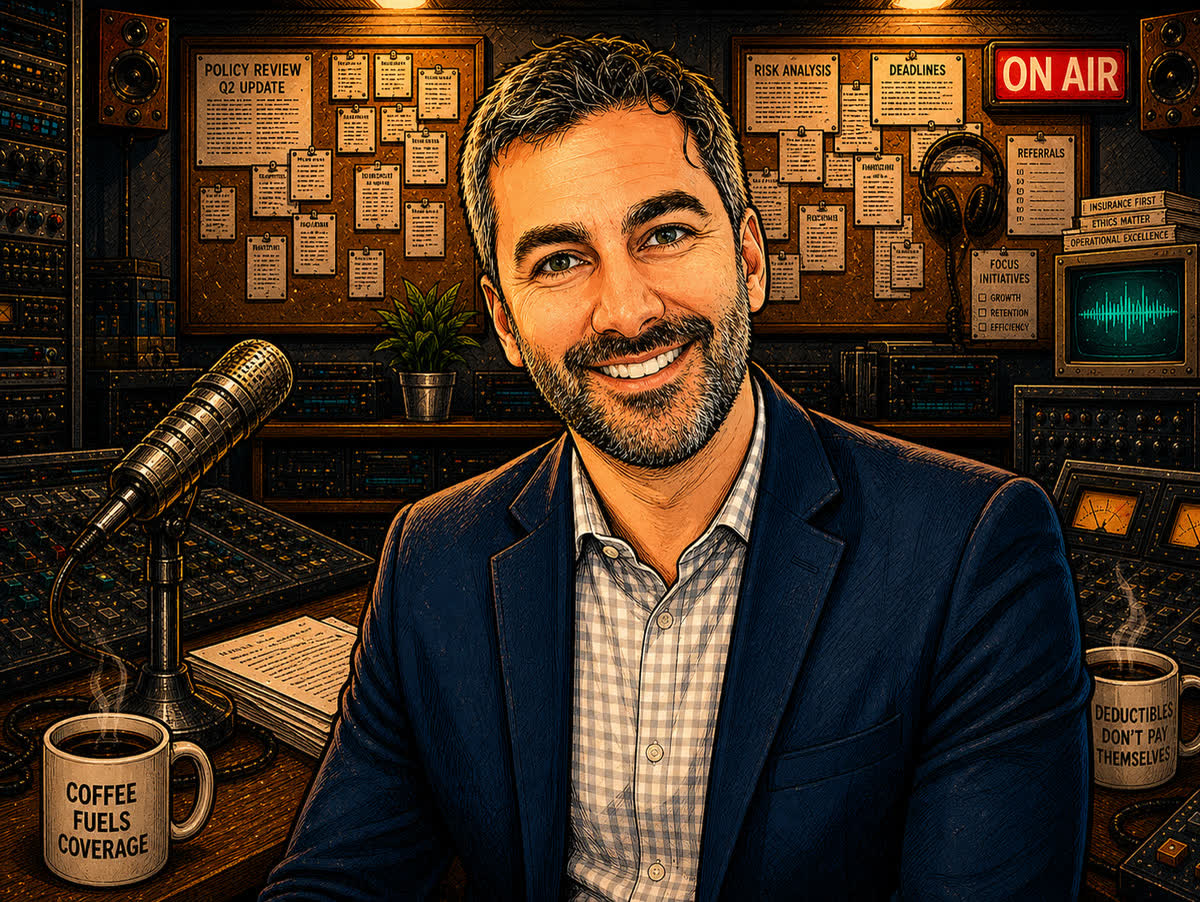
AI makes human skills more valuable in insurance because the work AI handles best is the work that never built client loyalty. Kian Gohar names problem-solving, emotional intelligence, and curiosity as the three capabilities that decide which agencies win the AI era.
AI makes human skills more valuable in insurance because the work AI handles best is the work that never built client loyalty. Kian Gohar names problem-solving, emotional intelligence, and curiosity as the three capabilities that determine which agents thrive in an AI-augmented agency.
Who is Kian Gohar and why does his view of AI and human work matter?
Kian Gohar didn't arrive at his framework by accident. His career spans the intersection of technological innovation and organizational behavior, he spent years studying how exponential technologies transform industries and, more importantly, how humans adapt and thrive within those transformations. He's worked with Fortune 500 companies and built innovation programs that ask a foundational question: when the machine can do everything the algorithm can do, what can only a human do well?
For insurance specifically, that question has a clear set of answers. The tasks that AI handles beautifully are the tasks that are rule-based, data-intensive, and pattern-dependent. Underwriting algorithms, claims processing, renewal pricing, cross-sell recommendations, these are exactly the kinds of tasks where machine efficiency dramatically outpaces human speed. But the tasks that determine whether a client stays with you for 20 years? Those are categorically different.
Kian's conversation introduces the concept of "human-centric skills" not as a soft-skills talking point but as a strategic capability set. He identifies problem-solving, emotional intelligence, and genuine curiosity as the three skills that define which professionals will thrive in an AI-augmented workplace. These aren't the skills that show up on insurance licensing exams. They're the skills that determine whether a client in a complicated claims situation feels advocated for or abandoned.
The implications for agency hiring and training are immediate. If the most valuable thing an agent brings to a client relationship is the ability to navigate ambiguity, manage emotion, and ask genuinely insightful questions, how are you developing those capabilities in your team? Most agencies invest heavily in product knowledge and compliance training, and minimally in the human skills that actually drive retention and referrals.
How should agents communicate with AI to win an AI-saturated market?
One of the most actionable sections of the conversation centers on what Kian calls "effective communication with AI", which sounds technical until he clarifies what he actually means. The agents and agency owners who will get the most value from AI tools are the ones who can be precise about what they're asking for, evaluate the output critically, and integrate the AI's contribution into a human-centered client interaction.
This is a different kind of literacy than most people imagine when they talk about "learning AI." It's not about being a programmer or a prompt engineer. It's about understanding what AI is good at, pattern recognition, summarization, data analysis, first-draft generation, and what humans are better at, judgment, relationship management, emotional navigation, creative problem-solving, and combining them intelligently.
An agent who uses AI to prepare for every client conversation, researching the client's coverage gaps, summarizing their claims history, identifying potential needs based on life stage, and then shows up to that conversation with full human presence is going to dramatically outperform an agent who does the same research manually and arrives exhausted and distracted. The AI frees up cognitive bandwidth for the human work that actually builds the relationship.
Kian also introduces the concept of "curiosity as a professional asset", and this resonates deeply in an insurance context. The best agents are genuinely curious about their clients' lives. They ask questions that go beyond the application, they listen for the details that reveal real risk and real need, and they bring those observations back to the client in ways that demonstrate genuine engagement. AI can prompt the questions. Only a curious human can make the client feel truly heard in the answering.
What should your agency change about training this month?
The most immediate action from Part 1 of this conversation is a training audit with a different lens. Look at your last 90 days of producer training and evaluate how much of it was product knowledge, compliance, and systems versus how much was emotional intelligence, communication skills, and creative problem-solving. If the ratio is 90/10, you're preparing your team for a world that's rapidly disappearing.
Design one training interaction this month focused exclusively on listening and problem-solving. Role-play a difficult client scenario, a claim that's taking longer than expected, a premium increase that the client wasn't anticipating, a coverage gap that's only now becoming visible, and evaluate how your producers navigate the emotional dimension of that conversation. That's where the actual skill gap is.
Finally, experiment with one AI tool this week in a way that's explicitly designed to enhance human interaction rather than replace it. Use AI to generate a summary of a client's coverage before a renewal call. Use it to draft follow-up notes that you then personalize. Use it to research a client's industry before a commercial conversation. The goal is to arrive more prepared and more present, not to automate the relationship.
What is the bottom line on human skills in the AI era?
Kian Gohar's argument is ultimately hopeful: the skills that make insurance agents irreplaceable are human skills, and the rise of AI makes those skills more valuable, not less. The agencies that invest in emotional intelligence, creative problem-solving, and genuine curiosity are building a competitive moat that no algorithm can erode. Part 2 goes deeper into the specific frameworks Kian uses to develop these capabilities at scale.
Catch the full conversation:
Level up your agency:
Listen to The Insurance Dudes Podcast
Get more strategies like this on our podcast. Available on all platforms.
Related Episodes

Adam Pisani's 19 Years: Why Fire in the Belly Still Matters
Bryan Taylor: Positivity Is a Strategy, Not a Trait (Part 1)
Bryan Taylor's Playbook for Culture When Numbers Are Hard
How Insurance Agents Can Use ChatGPT to Stay Competitive

Chris Cheatham on Why He Left Law to Build Insurtech AI
