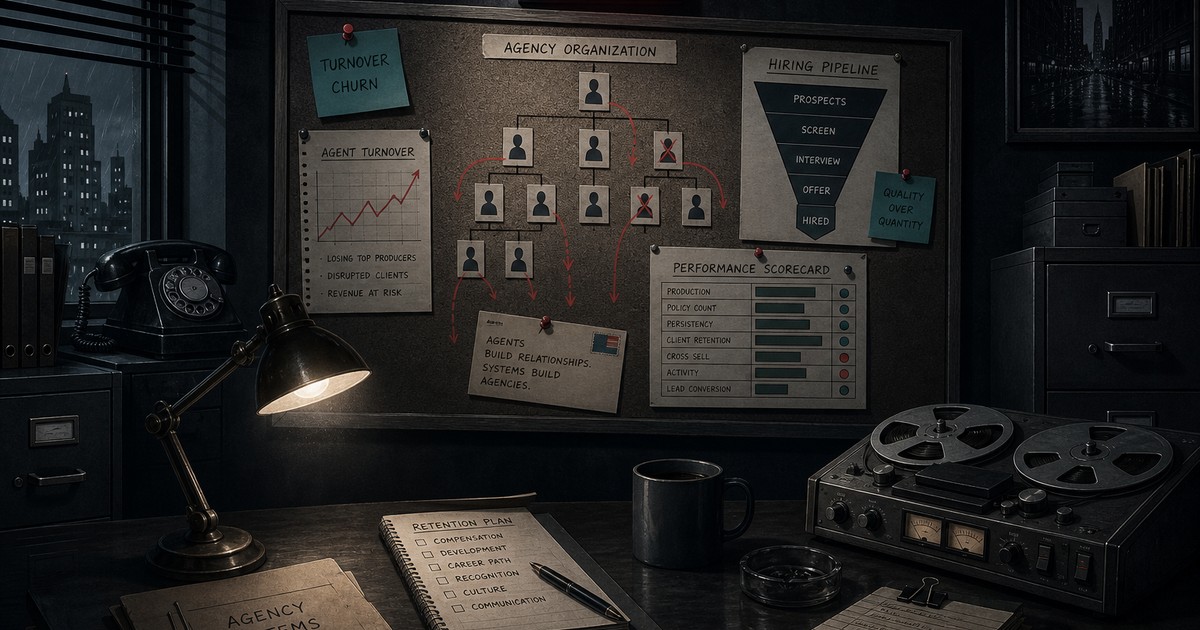
The People Problem: Recruiting, Training, and Letting Go
Craig and Jason are licensed P&C agency owners, co-authors of Million-Dollar Agency, creators of the trademarked Telefunnel, hosts of The Insurance Dudes podcast, and speakers.
Written and reviewed under our editorial process. Found an error? See our corrections policy.

Solve the insurance agency people problem by filtering candidates on values alignment first and competence second, running behavior-based interviews, training for culture in the first 30 days, and separating clearly when performance gaps persist. Waiting to fire is the most expensive decision owners make.
Solve the insurance agency people problem by filtering on values alignment before competence, running behavior-based interviews with a "would you rehire" reference question, treating the first 30 days as culture confirmation, and separating early when performance gaps persist. The four stages are recruiting, hiring, training, and letting go.
Why does the people problem keep repeating in your agency?
If you've hired someone who looked great in the interview and turned into a headache within 90 days, you've experienced the most common people failure in insurance agencies. If it's happened more than once, there's usually a pattern, and the pattern almost never has to do with your ability to read people.
It has to do with what you were evaluating. Most agency hiring processes screen heavily for technical competence (do they know insurance?), sales track record (what were their production numbers?), and likability (did I enjoy talking to them?). All three of those things matter, but none of them predict whether someone will thrive in your specific agency's culture.
Craig Pretzinger found that the candidate who aligned with the agency's values and principles consistently outperformed the candidate with better credentials who didn't. This doesn't mean ignoring competence, it means using values alignment as a filter that competence has to pass through, not the other way around.
How do you recruit a stronger applicant pool?
Recruiting for an insurance agency isn't just about finding people who want to sell insurance. It's about finding people who want to be part of what your agency is specifically doing. This requires that you actually have something specific and compelling to communicate about your agency, which circles back to your Purpose.
The agencies that attract the best candidates aren't necessarily the ones paying the most. They're the ones that have a clear story about what they're building and can communicate why a talented person should want to build it with them. That story has to be genuine. Talented candidates can distinguish between an agency that actually has a vision and an agency that borrowed language from a business book.
Structured job postings that reference your actual principles and invite people who share them will produce a different applicant pool than generic job postings. And referrals from your current strong performers are significantly more likely to produce quality hires than any job board, because strong performers tend to know other strong performers.
Why isn't the interview a sales pitch?
Too many agency owners use the interview as an opportunity to sell candidates on the job rather than thoroughly evaluate whether the candidate is right for the agency. This inverts the power dynamic in a way that produces bad hires.
A structured interview process uses consistent, behavior-based questions for every candidate: "Tell me about a time you disagreed with your manager's decision. What did you do?" "Describe a situation where you had to tell a client something they didn't want to hear. How did you handle it?" These questions reveal how candidates actually behave, not how they imagine they behave when they're trying to make a good impression.
Values-alignment assessment is equally important. Ask directly about the things your agency's principles address. If one of your principles is "client care over production," ask candidates to describe a situation where they had to choose between those things and what they chose. Their answer and their comfort level with the question tells you a great deal.
Reference checks should be substantive. "Would you rehire this person if you had the opportunity?" is the single most revealing reference question because it's binary and direct. Most reference givers will hedge around general quality questions but give themselves away on this one.
Why should training focus on alignment before skill?
The first 30 days of a new hire's tenure should be as focused on culture and principles as on product knowledge and sales process. New hires are making a fundamental assessment during this period: is this place what it claimed to be? Are the values real? Is the management team behaving in alignment with what they told me during recruiting?
If the answer is no, if the culture they encounter is different from the culture that was described, you will lose the people you most want to keep. The ones with options will leave. The ones without options will stay, and they'll be disengaged. Training is not just skill transfer. It's culture confirmation.
How do you let someone go early, clearly, and without drama?
The hardest people decision for most agency owners isn't hiring, it's the long, painful process of recognizing that someone isn't working out and doing something about it. Most agencies wait far too long, hoping that performance will improve, reluctant to add the recruitment and training cost of replacing someone, or conflict-averse in ways that prolong the problem.
The cleaner approach: define your performance standards clearly before you hire anyone. When a team member isn't meeting those standards, have a direct, documented conversation about the specific gaps and the timeline for addressing them. If the standards aren't met, act. Every week you delay costs you more, in team morale, in management time, and in the continued drag on your agency's performance.
Who on your team needs the next important conversation?
Audit your current team against your agency's stated principles, not just their production numbers. Who is doing both, performing and representing what the agency stands for? Who is doing one but not the other? The second group is where your most important conversations need to happen.
Why is People the most operationally complex pillar of the 5 Ps?
The People pillar isn't soft, it's the most operationally complex piece of the 5 Ps because you're working with human beings who are unpredictable and nuanced. But a clear approach to each stage of the people cycle, recruiting, hiring, training, and separation, transforms team-building from an ongoing crisis into a system that produces the right people consistently.
Catch the full conversation:
Level up your agency:
Listen to The Insurance Dudes Podcast
Get more strategies like this on our podcast. Available on all platforms.
Related Episodes

Tony Canas on Why Agencies Fail to Recruit Young Producers
5 Hiring Hacks for P&C Agency Owners to Retain Top Talent
Train to Retain: Your Turnover Problem Is a Training Problem
5 Hiring Mistakes P&C Agency Owners Must Stop Making
Why Hiring Is the Number One Challenge for Agency Owners