How Can Insurance Agencies Turn Hiring Nightmares Into a 5-Step System That Works?
Hosts of The Insurance Dudes Podcast. 1,000+ episodes helping insurance agents build elite agencies.

Most insurance agencies hire the same way they did a decade ago and wonder why results do not change. A structured five-step system, from outcome-based role definition through a deliberate 90-day ramp, cuts time-to-hire and doubles retention. The process is the problem, not the people.
Insurance agencies burned by bad hires do not have a people problem: they have a process problem. When Jason and Craig sat down across the mics for this mailbag episode, the stories pouring in from agency owners made one thing clear: most independent agencies hire on gut feel, drag the process out for months, make a shaky offer, and then hand the new person a login and a prayer. No system, no scorecard, no ramp. Then they are shocked when it bombs. The agencies that win the talent game in 2026 are the ones running a repeatable five-step hiring system, not lucking into great people.
What is the actual cost of a bad hire for an insurance agency?
Agencies do not calculate this number, which is why they keep eating it. The U.S. Department of Labor estimates a single bad hire costs at least 30% of the employee's first-year earnings, and SHRM places the replacement cost between 50% and 200% of annual salary depending on seniority U.S. Department of Labor / SHRM. For a producer earning $80,000 in year one, that is $24,000 minimum before accounting for the book of business they did not write, the service staff hours burned cleaning up mistakes, the carrier relationships strained by sloppy submissions, and the morale hit the team takes when someone washes out in month seven.
Insurance Journal reports that time-to-hire for account managers ballooned from 60 to 90 days to over six months in 2024 as agencies pulled back from remote hiring Insurance Journal, Jan 2025. Every extra week a role sits open costs revenue. The math is not complicated: a broken hiring process is the single most expensive line item most agency owners never track.
Why do most insurance agency hiring processes fail before they even start?
The failure starts at step zero: the job description. Most agencies copy-paste a generic CSR or producer posting from Indeed, list fifteen bullet points of "requirements," and call it a day. The 2026 Insurance Journal recruiting analysis identifies unqualified applicant floods as the number-one recurring problem, driven by bloated job ads that attract anyone with a pulse Insurance Journal, Feb 2026. The fix is writing a tight, outcome-based role description: not "must have five years of commercial lines experience" but "will manage a $400K renewal book and place $75K in new business in year one." Specificity filters candidates before they ever hit apply.
The second pre-start failure is no sourcing strategy. MarshBerry's research on high-growth firms shows the top performers hire talent newer to the industry: interns, recent college grads, quality people from service industries, and build bench strength proactively rather than posting and praying when a seat opens MarshBerry. The agencies that stay fully staffed are always recruiting, not just recruiting when they are desperate.
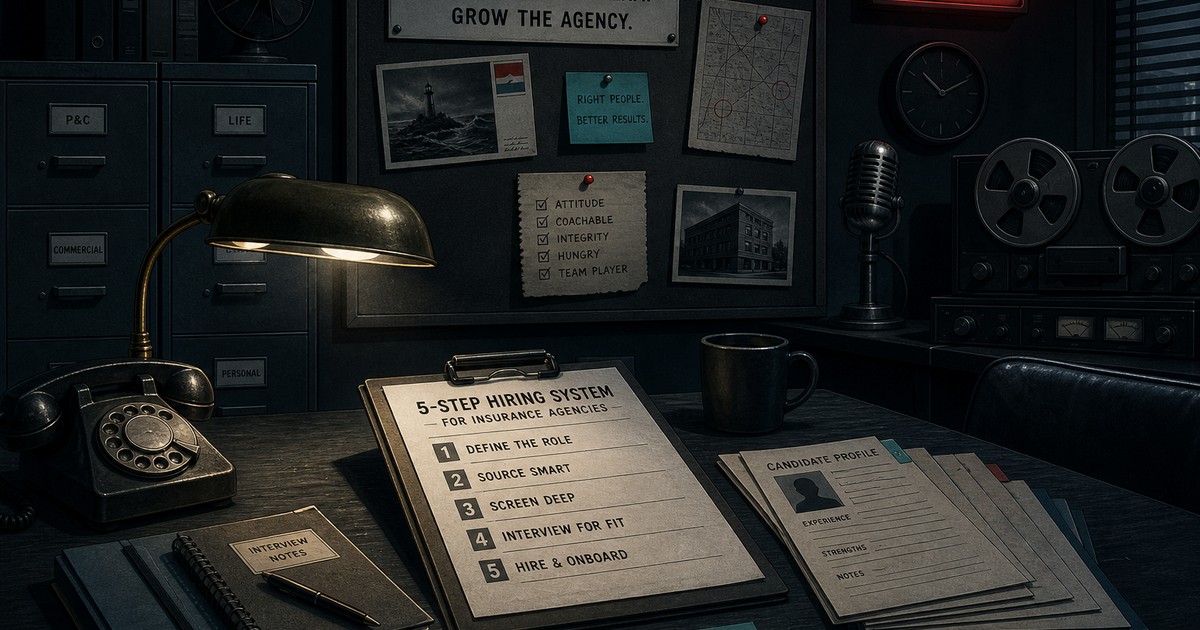
What is step one of a hiring system that actually works?
Define the role around outcomes, not activities. Before you write a single word of a job posting, answer three questions: What must this person accomplish in the first 90 days? What metrics determine success at six months and twelve months? What does "great" look like versus "gone"? Write a one-page scorecard that a third grader could understand. If you cannot define success for the seat, you cannot evaluate candidates for it and you will default to hiring the person who interviews best, which is the worst possible filter.
The Big "I" Best Practices Study, conducted annually with Reagan Consulting for over 32 years, consistently finds that top-performing agencies operate from clearly defined roles with measurable expectations Big "I" Best Practices. This is not theory. The agencies running scorecard-based hiring fill seats faster, retain longer, and promote from within at roughly double the rate of agencies hiring on instinct.
What is step two and how do you source beyond the job board?
Step two is building a pipeline before you have an opening. The data supports urgency here: approximately 400,000 insurance industry positions are projected to go unfilled over the next decade as retirements accelerate, with roughly 50% of the current insurance workforce aged 55 and older expected to retire by the early 2030s BLS / US Chamber of Commerce via ProducerFlow. There are 1.37 million insurance professionals aged 55 or older, nearly one in four workers, against only about 214,000 aged 20 to 24. That is a six-to-one ratio of people heading out the door versus people walking in. The agency that waits until a key CSR gives notice to start looking has already lost.
Practical sourcing channels that work for agencies under $5M in revenue:
- Stay connected to every strong candidate you interviewed but did not hire. One in four becomes a fit for a different seat within eighteen months.
- Build relationships with the two or three local independent adjusters and underwriters who see talent move between agencies. They know who is unhappy before LinkedIn does.
- Run a structured referral program with real money attached: $1,500 to $3,000 paid out after the new hire hits six months. Your own team is your best recruiter, but only if you incentivize it.
The Insurance Journal analysis of 2025 recruiting challenges notes that effective job advertisements are short, load the top section with specifics, and pair posting links with videos and employee testimonials on social media Insurance Journal, Jan 2025. The agency with a fifteen-second phone video of a team member saying why they love working there will beat the agency running a 500-word HR-approved job description every single time.
What is step three and how do you run an interview process that does not drag on?
Three interviews, max. Anything beyond three and you are performing theater, not evaluating fit. The data is clear: candidates lose patience and question the process after the third interview Insurance Journal, Jan 2025. Structure it:
- Interview one (30 minutes, phone or video): Screen for the scorecard. Can they do the job? Confirm compensation range alignment. No more than five questions.
- Interview two (60 minutes, in person or video): Deep dive on the top three competencies. Use behavioral questions only: "tell me about a time you," not hypotheticals. Run a short work sample: have a CSR candidate handle a mock COI request or a producer candidate prepare a three-minute pitch on a real agency account.
- Interview three (45 minutes, team panel): Two or three team members who would work alongside this person. Culture check. This replaces the parade of one-on-ones that kills momentum. Debrief within 24 hours; decision within 48.
The 2026 Insurance Journal recruiting analysis emphasizes that structured timelines are non-negotiable: interview debriefs within 24 hours, final feedback within 48 hours, and hiring managers held accountable to those deadlines Insurance Journal, Feb 2026. Ghosting is a two-way street, and in an industry where everyone knows each other, the agency that goes dark on candidates develops a reputation that poisons the sourcing well.
The "gotcha moment": discovering in interview three that the candidate has a strict non-compete, needs $15K more than you budgeted, or holds three competing offers is a direct result of poor intake. Pre-screen comp, non-compete status, and timeline in the first conversation. If you get surprised late, your process failed, not the candidate.
What is step four and why does offer speed determine whether you land the hire?
Make a fast, decisive offer. The single biggest unforced error agency owners make is stretching the gap between final interview and written offer. Every day that passes, the candidate talks to someone else, the current employer counteroffers, or doubt creeps in. If the third interview happens on a Tuesday, the written offer with comp, benefits summary, and the 90-day plan needs to be in their inbox by Thursday at noon.
About 53% of insurance carriers expect to increase staff in the next twelve months Jacobson / Aon Labor Market Study via Insurance Journal. The competition for talent is real. The agency that moves fast on a strong candidate wins. The agency that "needs to think about it" loses.
The offer itself should restate the scorecard: "Here is exactly what we agreed you would accomplish in the first 90 days, here is the support you get, here is the comp structure that rewards hitting those outcomes." This is also the moment to address the restrictive covenant question head-on. If the candidate has a non-compete or non-solicitation from a prior firm, do not treat it as their problem: partner with them on a solution. A brief legal review costs less than a failed hire who gets sidelined by a demand letter in month three.
What is step five and how does a 90-day ramp determine whether the hire succeeds?
The hire is not done when they accept the offer. It is done when they are fully productive, which takes deliberate onboarding: not a login, a compliance video, and a wave. MarshBerry's data shows high-growth firms "rethink their traditional onboarding and learning program for new talent" and invest in coaching and mentoring from day one MarshBerry. Eighty-eight percent of insurers that develop talent internally rather than relying on external hiring report 37% better retention and 23% faster time-to-productivity Sonant AI.
The 90-day ramp has five components:
- Week 1: Systems access, carrier appetites, team introductions, client book walk-through. No solo work yet, shadow only.
- Weeks 2 to 4: Co-pilot mode. They handle the work, you review before it goes out. Daily fifteen-minute check-ins.
- Week 5: First solo week with a reduced load. Mistakes are expected and treated as coaching opportunities, not performance issues.
- Week 6 to 8: Full load with weekly one-on-ones. Check scorecard metrics against the 60-day target. Adjust if something is off; do not wait for the 90-day review.
- Day 90: Formal review against the scorecard. Decision point: green (keep and expand), yellow (extend ramp with specific milestones), or red (exit cleanly). No surprises: if someone hits red at day 90, the check-ins failed.
The insurance agency turnover rate sits at roughly 16.4%, below the broader financial services sector at 20-25% MarshBerry via Sonant AI. The firms beating that average are the ones running structured onboarding with defined milestones, not the ones crossing their fingers.
What does a good hire cost versus what a bad hire wastes?
Agencies often choke on compensation but ignore the cost of vacancy and churn. The U.S. Department of Labor pegs a bad hire at a minimum of 30% of annual salary U.S. DOL. For a $60,000 CSR, that is $18,000 wasted. For a $100,000 producer, it is $30,000, and that does not include the revenue the seat should have generated. Pay competitively, define the outcomes the salary buys, and hold the scorecard. The money you think you are saving by paying 15% below market gets spent twice when the seat turns over in eight months.
Agencies running this five-step system define the outcome, source proactively, interview in three tight stages, offer fast, and ramp deliberately, fill seats in weeks instead of months, retain hires beyond the first year at roughly double the industry rate, and stop treating hiring like an emotional roller coaster they ride twice a year.
What is the bottom line on building a hiring system that outlasts your worst instincts?
The agency owners who told Jason and Craig their hiring horror stories all had one thing in common: they hired reactively, on emotion, with no system between them and a bad decision. The fix is not a better gut: it is a process that protects you from your gut. Define the outcome before you define the person. Source before you are desperate. Interview in three steps with a scorecard and a deadline. Offer within 48 hours with the 90-day plan attached. Onboard like the first quarter determines whether the seat works, because it does. No single hire will make or break your agency, but a broken hiring process will grind your growth to a halt. Fix the system, and the people take care of themselves.
Sources cited in this analysis?
- Big "I" Best Practices Study: independentagent.com
- Insurance Journal: Big Recruiting Challenges Ahead for Insurance Agencies in 2025
- Insurance Journal: The Challenges of Insurance Recruiting (Feb 2026)
- Insurance Journal: Carrier Revenue Growth Expected to Outpace Hiring (Jacobson/Aon study)
- ProducerFlow: US Insurance Agency & Producer Statistics 2026
- MarshBerry: Talent Supply & Demand in the Insurance Industry
- Sonant AI: Insurance Agency Employee Turnover: 2026 Retention Strategies
- U.S. Department of Labor / SHRM: Cost of a Bad Hire Statistics
Listen to The Insurance Dudes Podcast
Get more strategies like this on our podcast. Available on all platforms.
Related Episodes
From Hiring Nightmares to Hiring Heroes: A 5-Step System That Actually Works for Insurance Agencies

Unburdened and Unstoppable: Cassidy Arbeli Finishes the Delegation Playbook (Part 2)
Unburden Your Business: Cassidy Arbeli on Delegation and Operations (Part 1)

Premium Billing Mastery Continued: Landon Completes the Playbook (Part 2)
Brett Young's Mega Agency Playbook: The Operational Moves That Drive Scale (Part 2)